
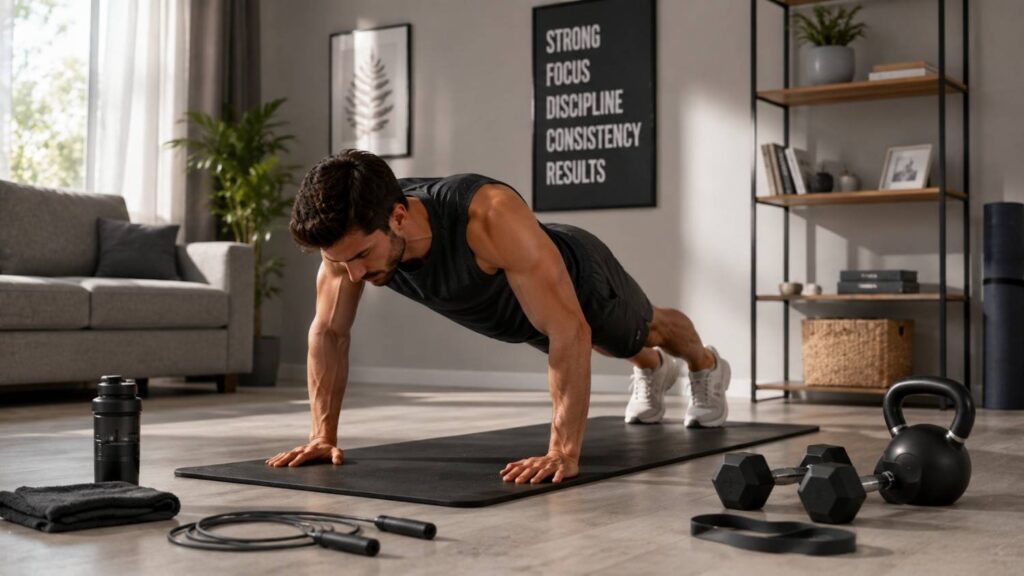
How to Use Minimal Equipment for Effective Workouts: A Practical Home Training Guide
Learning how to use minimal equipment for effective workouts can make regular exercise easier to afford, easier to schedule, and easier to maintain over the long term. A useful training space does not have to contain multiple machines, a power rack, stacks of plates, or specialized cardio equipment. For many general fitness goals, your own body weight plus a resistance band or a pair of dumbbells can provide enough options to build a well-rounded program.
The important distinction is between equipment variety and training quality. Owning many exercise tools gives you more choices, but those choices do not automatically produce better results. Effective training still depends on selecting appropriate exercises, applying sufficient resistance, using controlled technique, training major muscle groups consistently, and making the program progressively more demanding as your ability improves.
Current guidance supports this practical approach. ACSM’s 2026 resistance-training position stand synthesizes evidence from 137 systematic reviews and more than 30,000 participants. Among its major conclusions is that nontraditional resistance-training approaches—including bodyweight exercise, elastic bands, and home-based routines—can produce meaningful improvements in strength, hypertrophy, and physical function.
Physical activity should also extend beyond strength sessions. WHO currently recommends that adults accumulate 150–300 minutes of moderate-intensity aerobic activity per week, 75–150 minutes of vigorous activity, or an equivalent combination, while also performing muscle-strengthening work involving major muscle groups on two or more days.
For beginners, this means there is no need to postpone exercise until a perfect home gym exists. Start with the space and tools you already have, build a balanced routine, and expand your equipment only when a genuine programming need appears.
Why Can Minimal Equipment Workouts Be Effective?
Minimal equipment workouts can be effective because the human body responds to training stimulus, not to how expensive or complicated the equipment looks. Resistance training works when muscles are required to produce meaningful force against a challenge that is appropriate for the individual’s current ability. That challenge can come from a barbell, a cable machine, a resistance band, a dumbbell, gravity, or a carefully selected bodyweight exercise.
This point matters because people often confuse access to a large gym with access to effective exercise. A commercial facility provides useful variety and may be necessary for specific strength or athletic goals, but most general fitness objectives do not require dozens of machines. A push-up can challenge the chest, shoulders, and triceps. A split squat can provide substantial lower-body resistance. A band or dumbbell row can train the upper back. Hip hinges, bridges, carries, and core exercises can cover additional movement needs.
The effectiveness of a minimalist approach depends on how intelligently those exercises are programmed. If the same easy bodyweight routine is repeated for months without progression, results can eventually stall. If the exercises are gradually made harder, however, the limited equipment remains useful for much longer.
Current ACSM guidance reinforces this principle. Its 2026 position stand states that elastic bands, bodyweight exercises, and home-based resistance training can produce notable improvements in strength, muscle growth, and physical function. The same guidance emphasizes that the largest practical improvement often comes from moving from no resistance training to consistent resistance training.
This makes minimal equipment especially useful for beginners, busy professionals, travelers, and anyone who values convenience. The goal is not to prove that equipment is unnecessary. It is to recognize that a small amount of well-chosen equipment can support a surprisingly complete program.
Resistance Matters More Than Having Lots of Equipment
Muscles do not know whether resistance comes from an expensive machine or a low-cost elastic band. What they experience is tension and effort. When an exercise requires the muscles to work harder than they are accustomed to, repeated exposure to that challenge can stimulate adaptation. Over time, this is one of the foundations of improving muscular strength and performance.
This is why bodyweight exercises can be highly useful. A standard push-up may be difficult for a beginner, while an experienced trainee may need a decline variation, slower tempo, additional resistance, or another pressing exercise to create an appropriate challenge. The tool remains simple, but the difficulty changes according to the user.
Resistance bands work similarly. A lighter band may suit rehabilitation-style movements or beginners, whereas stronger bands can significantly increase the difficulty of rows, presses, squats, hinges, and arm exercises. Dumbbells provide another convenient way to increase external resistance in predictable increments.
ACSM’s 2026 resistance-training update specifically identifies elastic bands, bodyweight exercise, and home-based routines as effective nontraditional options for improving strength, hypertrophy, and physical function.
The practical lesson is to judge an exercise by the stimulus it creates. If an exercise is too easy, modify it. If it is so difficult that technique deteriorates immediately, regress it. Equipment is simply a tool for creating the appropriate level of resistance.
Consistency Is the Real Advantage of a Simple Setup
The strongest advantage of a minimal setup may not be physiological at all; it may be behavioral. When exercise requires fewer preparations, fewer purchases, less travel, and less decision-making, it becomes easier to fit into ordinary life.
Consider the difference between two routines. One requires driving 20 minutes to a gym, changing clothes, finding parking, waiting for equipment, and driving home. The other requires moving a chair, taking a resistance band from a drawer, and beginning within a few minutes. Both can be effective, but the second has fewer opportunities for daily friction to prevent the workout.
This does not mean everyone should abandon a gym. Many people enjoy the social environment, heavier equipment, classes, or wider exercise selection. The point is that the best environment is usually the one you can use consistently.
ACSM’s current resistance-training guidance places significant emphasis on this idea. Its 2026 infographic summarizes the principle directly: the most useful resistance-training plan is one that fits the person’s schedule, goals, comfort, and ability to continue over time.
Minimal equipment also reduces programming overload. Instead of choosing among dozens of machines, you can focus on a small number of fundamental exercises, learn them properly, and track improvement clearly.
For beginners in particular, that simplicity is valuable. Consistent practice of six well-selected movements can be more productive than constantly changing between 30 exercises without building competence in any of them.
Related Articles
What Minimal Workout Equipment Do You Actually Need?
The amount of equipment you need depends on your goals, available space, current strength, and preferred training style. Someone focused on general health may need nothing more than bodyweight exercises and regular walking. Someone pursuing more substantial strength or muscle development will eventually benefit from greater resistance. The key is to add equipment in response to a training limitation rather than purchasing items simply because they appear on a standard home-gym checklist.
For most people, the best starting point is body weight plus one versatile resistance tool. Resistance bands are inexpensive, portable, and particularly useful because they make pulling exercises possible in situations where bodyweight pulling is difficult. A pair of dumbbells—or preferably adjustable dumbbells if budget allows—adds another layer of versatility by making lower-body, upper-body, and loaded-carry exercises easier to progress.
An exercise mat can improve comfort for floor-based movements but does not create resistance. A stable bench or step can expand options for step-ups, supported rows, split squats, and pressing variations, although it is not essential. Other accessories such as suspension trainers, kettlebells, pull-up bars, or sliders can be useful later but should not be viewed as mandatory.
One thing I recommend before buying equipment is listing the movements your current setup cannot train adequately. If pushing exercises are easy but you have no practical way to train your back, a resistance band makes more sense than another pushing accessory. If your bodyweight squats have become too easy, adjustable dumbbells may solve the more important limitation.
Minimal-equipment training works best when every purchase has a clear function. The objective is not to collect compact fitness products. It is to build the smallest practical toolkit that allows balanced training and continued progression.
Start With Bodyweight Exercises
Bodyweight exercises provide the most accessible entry point into resistance training because the equipment is already available. Squats, split squats, lunges, glute bridges, calf raises, push-ups, planks, side planks, dead bugs, and similar movements can create a useful full-body foundation without requiring a dedicated training room.
Their biggest advantage is scalability. A beginner who cannot perform a floor push-up can start with hands on a stable elevated surface. As strength improves, the hands can gradually move lower until standard floor push-ups become manageable. Later progressions might include slower repetitions, pauses, decline push-ups, or added external resistance.
If you’re looking for more examples of minimal-equipment exercises, this resource offers additional movement ideas that align well with a simple home-training approach.
Lower-body movements can be adjusted in the same way. A basic squat may develop into a pause squat, split squat, reverse lunge, step-up, or assisted single-leg variation. Changing leverage or shifting more work to one limb can substantially increase difficulty without adding equipment.
Bodyweight training does have limits. Some muscle groups are harder to load progressively without external resistance, and pulling movements are particularly challenging when there is no secure bar, suspension system, band anchor, or weight available.
That is why bodyweight training should be treated as the foundation rather than as an ideology. Start with it because it is accessible and effective, then add equipment when doing so allows better balance or progression.
The U.S. Physical Activity Guidelines explicitly include bodyweight calisthenics such as push-ups, pull-ups, and planks among examples of muscle-strengthening activities.
Add One or Two Versatile Resistance Tools
Once bodyweight training no longer provides enough variety or resistance, a small number of multipurpose tools can transform the program. For most home users, resistance bands and dumbbells offer the best balance between exercise variety, storage requirements, and ease of progression.
Resistance bands are especially useful for upper-body pulling. Rows, pulldown-style movements, face pulls, curls, triceps extensions, presses, lateral raises, and assisted exercises can all be performed with relatively little space. Bands also travel easily, making them practical for hotel rooms or temporary living situations.
Dumbbells provide a different type of resistance. Because their load remains determined by gravity rather than band stretch, they work naturally for goblet squats, Romanian deadlifts, lunges, overhead presses, floor presses, rows, curls, and loaded carries. Adjustable models can reduce storage demands while offering several resistance levels.
| Equipment | Space Needed | Useful For | Priority |
|---|---|---|---|
| Body weight | None | Squats, push-ups, lunges, core exercises | Essential foundation |
| Resistance bands | Very low | Rows, presses, assistance, isolation work | High |
| Adjustable dumbbells | Low | Squats, hinges, presses, rows, carries | High |
| Exercise mat | Low | Floor work, mobility, comfort | Optional |
| Stable bench or step | Moderate | Step-ups, supported movements | Optional |
The best purchase is the one that removes the biggest limitation from your current routine. Avoid accumulating equipment before you know how it will improve your program.
For additional practical ideas on combining basic equipment into balanced training sessions, this guide to effective home workout routines provides examples that complement the principles discussed here.
| Equipment | Best For | Main Benefits | Ideal User |
|---|---|---|---|
| Bodyweight | Full-body training | No cost, no storage, beginner-friendly | Beginners and travelers |
| Resistance Bands | Strength and mobility | Lightweight, versatile, easy to store | Home workout enthusiasts |
| Adjustable Dumbbells | Progressive strength training | Easy load progression, multi-purpose | Intermediate users |
| Exercise Mat | Floor exercises and stretching | Improves comfort and stability | All fitness levels |
| Stable Bench or Step | Lower-body and support exercises | Adds exercise variety | Users with dedicated workout space |
How Do You Build an Effective Minimal-Equipment Workout?
Building an effective workout begins with movement coverage and progression, not with choosing exercises at random. The program should train the major muscle groups through complementary movement patterns while remaining simple enough that you can repeat it consistently and measure improvement.
A useful full-body structure includes a knee-dominant lower-body movement such as a squat or lunge, a hip-dominant movement such as a Romanian deadlift or bridge, an upper-body pushing exercise, an upper-body pulling exercise, and at least one movement that develops trunk stability. Single-leg training and loaded carries can provide additional value when appropriate.
This structure helps avoid a common home-workout problem: overtraining what is convenient. Push-ups and abdominal exercises require almost no setup, so people may perform large volumes of them while neglecting the upper back, hamstrings, hips, and lower body. A movement-based framework creates better balance.
Training volume should be appropriate for your ability. Beginners do not need to perform every exercise for many sets. Starting with a manageable workload allows time to learn technique and determine how the body responds. More experienced trainees can add sets, resistance, or additional exercises based on their goals.
Progression should also be deliberate. The U.S. Physical Activity Guidelines describe muscular development as progressive over time and note that increases in resistance, repetitions, sets, or training frequency can provide greater challenge as strength improves.
I recommend keeping the first version of a home routine intentionally simple. Choose a small number of exercises that can be performed safely and repeated for several weeks. Record what you do, notice where progress occurs, and change variables only when there is a reason.
A good program is not the one that contains the most exercises. It is the one that lets you train the whole body, recover appropriately, and become measurably more capable.
Cover the Major Movement Patterns
Organizing a workout around movement patterns creates a simple framework that is easier to understand than memorizing dozens of individual exercises. Different coaches may categorize movements slightly differently, but a practical home program can be built around six basic areas.
Squatting trains the knees and hips together. Bodyweight squats, goblet squats, and split squats are common examples. Hinging emphasizes movement around the hips and can be trained through glute bridges, Romanian deadlifts, or banded hip hinges.
Pushing includes exercises such as push-ups, floor presses, and overhead presses. Pulling balances that work with rows, pulldown-style band exercises, or other movements involving the back and elbow flexors.
A single-leg movement, such as a reverse lunge or step-up, can improve lower-body challenge without requiring very heavy resistance. Finally, core stability exercises such as dead bugs, side planks, and planks train the trunk to resist unwanted movement rather than simply producing repeated spinal flexion.
A minimal session might therefore include a goblet squat, band row, push-up, Romanian deadlift, reverse lunge, and dead bug.
There is no need to use a different exercise for each muscle. Compound movements train several areas simultaneously, which makes them particularly useful when time and equipment are limited.
The major-muscle-group approach also aligns with WHO and CDC guidance, which recommends muscle-strengthening activity that involves the main muscle groups of the body on at least two days each week.
Choose an Appropriate Level of Difficulty
An exercise should be challenging enough to require effort while still allowing you to maintain controlled technique. That middle ground is more useful than choosing either an exercise that feels effortless or one so difficult that every repetition becomes a struggle.
For beginners, the easiest way to regulate difficulty is through exercise variation and resistance. If floor push-ups are too difficult, elevate the hands. If ordinary squats are too easy, use a split squat, slower tempo, pause, resistance band, or dumbbell. Adjusting the exercise keeps the movement pattern similar while changing its demands.
You do not have to reach complete muscular failure during every set. ACSM’s 2026 position stand reports that training to momentary muscle failure did not consistently improve outcomes for the average healthy adult compared with appropriately challenging resistance training.
A practical approach is to end most sets while you still believe you could perform a small number of technically sound repetitions if necessary. Beginners should generally prioritize control and learning the exercise over deliberately pushing to maximum effort.
Rest periods should also suit the session. Harder strength-oriented sets may need more rest, while lighter circuits can often be performed with shorter breaks.
Progress should be visible over time. If an exercise that once required significant effort becomes easy at the same repetitions and resistance, that is a sign that the program should become more challenging.
What Does a Minimal-Equipment Full-Body Workout Look Like?
A minimal-equipment full-body workout should be simple enough to remember while still covering the major muscle groups. For many people, five or six carefully selected exercises are sufficient for a productive session. The goal is not to perform every possible movement in one day; it is to distribute work across the body without allowing one area to dominate the routine.
Before starting the main workout, spend several minutes preparing for the movements you will perform. A warm-up does not need to be elaborate. Comfortable walking, marching in place, arm movements, bodyweight squats, hip hinges, and easier practice repetitions can gradually increase readiness while giving you a chance to assess how you feel that day.
The strength portion can then combine lower-body, upper-body, and trunk exercises. You can perform them as traditional sets—completing several sets of one movement before continuing—or alternate between exercises. Circuits can save time, but moving quickly should never become more important than maintaining technique.
Beginners may start with one or two working sets per exercise and gradually increase workload. More experienced trainees can use additional sets or greater resistance. ACSM’s 2026 guidance emphasizes that training variables should ultimately reflect the individual’s goal rather than following a single universal formula.
Your weekly program should also include aerobic activity. Walking is often the easiest addition because it requires no equipment and can be accumulated in manageable amounts throughout the week.
A full-body plan is particularly efficient when training only two or three times weekly because each strength session gives the major muscle groups another exposure rather than dividing the body into many specialized training days.
Try This Simple Full-Body Routine
The following routine is designed as a flexible framework rather than a fixed prescription. Choose the variation and resistance that match your ability, and prioritize technique before adding difficulty.
| Exercise | Equipment | Suggested Approach |
|---|---|---|
| Squat or goblet squat | Bodyweight/dumbbell | Controlled repetitions through comfortable range |
| Push-up or incline push-up | Bodyweight | Choose an elevation that allows good form |
| Resistance-band row | Band | Pull smoothly and control the return |
| Reverse lunge or split squat | Bodyweight/dumbbell | Train both sides evenly |
| Romanian deadlift | Dumbbells/band | Control the hip hinge and return |
| Dead bug, side plank, or plank | Bodyweight | Maintain steady trunk position |
Begin with a manageable number of sets rather than trying to maximize volume immediately. The last few repetitions of each working set should feel meaningfully challenging, but technique should remain controlled.
You can complete all sets of one exercise before moving to the next, or pair movements that do not compete heavily—for example, squats with rows or push-ups with Romanian deadlifts.
If equipment is extremely limited, substitute exercises rather than abandoning the movement category. A glute bridge can replace a loaded hip hinge temporarily, while an elevated push-up can replace a dumbbell press.
Write down what you perform. Recording the resistance, variation, sets, and repetitions makes it easier to decide whether the next session should repeat or progress the workout.
Build a Realistic Weekly Schedule
A weekly schedule should reflect your recovery, experience, work demands, and other physical activity. There is no benefit in designing a technically perfect routine that conflicts with your normal life so badly that you cannot maintain it.
For many beginners, two full-body resistance sessions each week provide a practical starting point. A third session can be added later when recovery is good and the individual wants more training. ACSM’s current resistance-training guidance recommends training all major muscle groups at least twice weekly, while WHO and CDC similarly recommend muscle-strengthening activity on two or more days.
A simple week might look like this:
- Monday: Full-body resistance training
- Tuesday: Brisk walking or another moderate aerobic activity
- Wednesday: Rest, easy movement, or mobility
- Thursday: Full-body resistance training
- Friday: Walking, cycling, or other aerobic activity
- Saturday: Optional recreational activity or third strength session
- Sunday: Recovery or light activity
WHO recommends that adults accumulate 150–300 minutes of moderate-intensity aerobic activity or the vigorous-intensity equivalent each week in addition to strengthening major muscle groups.
You do not need to complete all aerobic activity in one session. Walking, cycling, active transportation, recreation, and structured cardio can contribute.
The most useful schedule is one that distributes challenging sessions sensibly and allows you to recover well enough to repeat them consistently.
How Can You Progress Without Buying More Equipment?
Progressive overload is the process of gradually increasing the training challenge as your body becomes more capable. In a commercial gym, adding another plate to a barbell is an obvious way to progress. Minimal-equipment training requires slightly more creativity, but additional weight is only one of several variables that can be adjusted.
Repetitions are one option. If you initially perform eight controlled repetitions and later perform twelve with the same resistance and technique, you have demonstrated progress. Sets can also increase, although adding more volume indefinitely is not always the most efficient strategy.
Exercise leverage provides another powerful tool. A wall push-up can progress to a countertop push-up, then to a lower surface, and eventually to the floor. Two-legged squats can develop into split squats or lunges, shifting more work onto each leg. Greater range of motion can increase difficulty where it is appropriate and comfortable.
Tempo can be manipulated as well. Slowing the lowering phase or adding a pause in a challenging position removes momentum and makes a familiar exercise more demanding. Resistance bands can be changed for stronger versions, while dumbbell users can increase weight.
The U.S. Physical Activity Guidelines explicitly describe muscle-strengthening development as progressive and note that increases in weight, repetitions, sets, or training frequency can increase the demand over time.
The important principle is that progression should be measurable and purposeful. Do not change five variables simultaneously because you will not know which adjustment produced the improvement.
A simple training log solves much of this problem. Write down the exercise, variation, resistance, repetitions, and sets. When performance becomes consistently easier with sound technique, make one small change and continue.
Use Smarter Progression Methods
Minimal equipment gives you several ways to increase difficulty before purchasing anything new. The best method depends on the exercise and your training goal, but progression should generally remain gradual enough that technique stays stable.
Useful progression options include:
- Add a small number of repetitions.
- Add another working set.
- Move to a stronger resistance band.
- Increase dumbbell resistance if available.
- Use a harder bodyweight variation.
- Increase range of motion when appropriate.
- Slow the lowering portion of the exercise.
- Add a pause at a difficult point.
- Reduce assistance.
- Shift from selected two-legged movements to suitable single-leg variations.
Consider a squat as an example. A beginner may start with a bodyweight squat to a chair. That can progress to an unrestricted bodyweight squat, a slower squat, a pause squat, a goblet squat, and eventually split-squat or lunge variations depending on the goal.
For push-ups, progression may involve gradually lowering the height of the supporting surface before adding repetitions or external resistance.
Avoid assuming that progression always means performing more repetitions. Once repetitions become very high, a more difficult variation or greater resistance may better match a strength-oriented goal.
ACSM’s current position stand emphasizes that training load and volume should be adjusted according to the desired outcome.
Track one or two variables that matter. Simple records make your home program far more systematic without making it complicated.
| Progression Method | How It Improves Training | Best Used When |
|---|---|---|
| Increase Repetitions | Builds muscular endurance before adding resistance | Current sets feel too easy |
| Add Extra Sets | Increases total training volume | Recovery is good |
| Use Stronger Resistance Bands | Adds greater muscle challenge | Existing band offers little resistance |
| Slow Down Exercise Tempo | Increases time under tension | Limited equipment is available |
| Perform Harder Exercise Variations | Improves strength without buying equipment | Basic movements become easy |
| Increase Range of Motion | Enhances muscle activation and mobility | Technique is already consistent |
| Add Isometric Pauses | Improves control and stability | Working on movement quality |
| Train One Limb at a Time | Increases difficulty using bodyweight | Additional weight isn’t available |
Avoid Common Minimal-Equipment Workout Mistakes
Minimal-equipment training becomes ineffective when simplicity turns into poor programming. One common mistake is repeating the same easy routine for months. The exercises may have been challenging initially, but once the body adapts, the program needs some form of progression.
Another mistake is neglecting pulling movements. Push-ups are easy to perform almost anywhere, so home routines often include significant pressing but little work for the upper back. A resistance band, sturdy pulling setup, or dumbbell can help correct this imbalance.
Constant exercise variation is another problem. Changing every movement in every session may feel interesting, but it makes progress difficult to measure. Keep important exercises consistent long enough to improve them before introducing unnecessary variety.
Technique can also deteriorate when people turn every home workout into a race. Circuits and short rest periods are useful in some contexts, but strength exercises still need control. Faster is not automatically better.
Training to exhaustion every session is unnecessary for most general fitness goals. ACSM’s 2026 review found that advanced approaches such as routine training to momentary failure did not consistently improve outcomes for the average healthy adult.
Finally, do not overlook recovery. Muscles need time between challenging sessions, and the entire program should fit your broader activity, sleep, work, and lifestyle demands.
The solution to most of these mistakes is surprisingly simple: use balanced movement patterns, repeat important exercises, track progress, and increase difficulty gradually instead of chasing exhaustion or novelty.
Quick Answer About How to Use Minimal Equipment for Effective Workouts
Learning how to use minimal equipment for effective workouts starts with understanding that the quality of a training program depends more on resistance, exercise selection, progression, and consistency than on the number of machines available. A basic setup can consist of your own body weight, a resistance band, and optionally one or two dumbbells. Those tools are enough to train major movement patterns such as squatting, hinging, pushing, pulling, lunging, carrying, and core stabilization.
The key is to choose exercises that are challenging for your current ability and make them progressively harder as you improve. That progression can come from adding resistance, increasing repetitions or sets, using a larger range of motion, performing harder variations, or improving control.
This approach is supported by current resistance-training evidence. The American College of Sports Medicine’s 2026 position stand states that bodyweight exercises, elastic bands, and home-based resistance routines can produce meaningful improvements in strength, muscle development, and physical function. ACSM also emphasizes that consistency matters more for the average healthy adult than complicated programming or advanced techniques.
A balanced minimal-equipment program should also sit within a broader active lifestyle. WHO recommends that adults perform muscle-strengthening activities involving all major muscle groups on at least two days each week while also accumulating regular moderate- or vigorous-intensity aerobic activity.
The practical takeaway is simple: start with a few versatile movements, train them consistently, record your progress, and increase the challenge gradually. More equipment can be useful later, but it is not a requirement for an effective start.
Frequently Asked Questions About How to Use Minimal Equipment for Effective Workouts
People researching how to use minimal equipment for effective workouts usually share the same concern: whether a simple home routine can actually provide enough resistance to improve fitness. The evidence suggests that the answer is yes, provided the program is sufficiently challenging, balanced across major muscle groups, and progressed over time.
The important qualification is that “minimal equipment” does not mean “minimal effort” or “random exercise.” A few tools can support effective training, but the exercises still need to be chosen according to the user’s ability and goals. A resistance band row needs enough tension to be challenging. A push-up variation should match current upper-body strength. Lower-body exercises need to become harder as basic squats become easy.
Equipment requirements also change over time. Someone beginning resistance training may make substantial progress with bodyweight movements alone. A more experienced trainee pursuing maximum strength will eventually need heavier resistance than a beginner. Minimalism should therefore be viewed as using only the equipment necessary for the next stage of training, not refusing useful tools.
Frequency is another common question. Current WHO, CDC, and ACSM guidance generally supports muscle-strengthening work for the major muscle groups on at least two days weekly.
People should also consider individual circumstances. Exercise that is appropriate for a healthy adult may need modification for pregnancy, chronic disease, pain, injury, significant mobility limitations, or rehabilitation.
The answers below address the most common questions about bodyweight exercise, bands, dumbbells, workout frequency, and whether a home routine can replace gym-based training.
Can you get an effective workout with minimal equipment?
Yes. A minimal-equipment workout can improve strength, muscular function, and general fitness when exercises provide sufficient resistance and are progressed over time.
ACSM’s 2026 resistance-training position stand specifically reports that bodyweight exercises, elastic bands, and home-based routines can produce meaningful benefits in strength, hypertrophy, and physical function. The organization also emphasizes that complex programming and specialized equipment are not required for the average healthy adult to benefit from resistance exercise.
The quality of the program remains important. A balanced routine should train the legs, hips, back, chest, shoulders, arms, and trunk rather than repeatedly focusing on only convenient movements such as push-ups and crunches.
Progression matters as well. Once an exercise becomes easy, increase the challenge through more resistance, harder variations, greater range of motion, additional sets, or other appropriate adjustments.
For general health and recreational fitness, minimal equipment can therefore be more than sufficient. People pursuing highly specialized strength, bodybuilding, rehabilitation, or competitive performance goals may eventually benefit from additional equipment or professional programming.
What is the best single piece of equipment for home workouts?
There is no universal best choice because the most useful tool depends on what your existing routine cannot do effectively. However, resistance bands are among the most versatile options for people who want a compact, inexpensive setup.
Their biggest advantage is that they make pulling exercises much easier to perform at home. Rows, pulldown variations, face pulls, curls, triceps work, shoulder exercises, and assisted movements can all be performed with bands. They are also extremely easy to store and travel with.
Adjustable dumbbells may be the better single investment for someone whose priority is progressive strength training. They make it easier to quantify resistance for goblet squats, Romanian deadlifts, presses, rows, lunges, curls, and loaded carries.
The ideal setup for many users is therefore not choosing between bodyweight, bands, and dumbbells but combining them. Bodyweight covers several fundamental movements, bands solve many pulling and assistance needs, and dumbbells provide convenient external loading.
Before buying anything, identify the largest gap in your current workout. Purchase equipment that solves that problem rather than following a generic list of home gym essentials.
Can bodyweight exercises build strength?
Yes. Bodyweight exercises can build strength when the movement is appropriately challenging for the individual. A push-up is a genuine resistance exercise, as are split squats, lunges, step-ups, bridges, pull-ups where suitable equipment exists, and many other calisthenic movements.
The U.S. Physical Activity Guidelines explicitly include bodyweight exercises such as push-ups, pull-ups, and planks as examples of muscle-strengthening activity.
The main challenge is progression. Beginners often improve quickly because standard bodyweight variations represent a significant resistance. As strength grows, the same movement may become too easy.
Progress can then come from harder leverage, greater range of motion, unilateral variations, slower lowering phases, pauses, additional repetitions, or external resistance.
For example, an incline push-up can progress to a floor push-up and later to a decline or weighted variation. A two-legged squat can develop into a split squat, lunge, or externally loaded squat.
Bodyweight training is therefore not inherently “beginner-only.” Its usefulness depends on whether you can continue finding variations that create an appropriate challenge for the target muscles and your specific goal.
How often should I do a minimal-equipment strength workout?
For most adults starting a general fitness program, training the major muscle groups on at least two days each week is a reasonable evidence-based target.
WHO recommends muscle-strengthening activity involving all major muscle groups on two or more days weekly. CDC provides the same broad recommendation for adults, while ACSM’s 2026 resistance-training guidance advises training all major muscle groups at least twice per week.
A beginner could therefore perform full-body sessions on Monday and Thursday, leaving several days between workouts. Another person might train Monday, Wednesday, and Friday if the total workload and recovery are appropriate.
Frequency should not be considered in isolation. Two very demanding sessions can create more total training stress than three shorter sessions. Exercise selection, sets, resistance, other physical activity, sleep, and individual recovery all matter.
If you are completely new to resistance training, start conservatively. Focus on learning the movements and establishing consistency before adding more training days.
People with health conditions, significant pain, rehabilitation needs, or other individual considerations may benefit from guidance from an appropriately qualified professional.
Do I need dumbbells if I already have resistance bands?
No. Resistance bands can support a broad range of strength exercises and may be enough for many home-training goals, particularly during the early stages of a program.
You can use bands for rows, presses, squats, hinges, curls, triceps extensions, lateral raises, assisted exercises, and many other movements. Using different band strengths also gives you several resistance levels without taking up significant storage space.
Dumbbells become useful when you want more predictable external loading or when certain exercises feel more natural with free weights. Goblet squats, Romanian deadlifts, one-arm rows, overhead presses, floor presses, lunges, and carries are all straightforward to load with dumbbells.
The two tools also complement each other. Bands provide resistance that changes as the material stretches, whereas dumbbells provide load through gravity. Neither is universally superior.
If your existing bands still allow you to challenge the target muscles and progress your exercises, there is no urgent reason to buy dumbbells.
Add equipment when your current setup begins limiting an important movement or goal. That principle keeps a minimal home gym genuinely minimal rather than gradually becoming a collection of rarely used accessories.
Is a home workout enough to replace a gym?
For general health, strength, muscular endurance, mobility, and recreational fitness, a well-designed home program can be completely effective. Current ACSM guidance explicitly recognizes home-based resistance training, elastic bands, and bodyweight exercises as productive options.
Whether home training can replace a gym for you depends on your goals. A beginner or intermediate exerciser may have everything necessary with bodyweight movements, bands, and adjustable dumbbells. Someone pursuing maximal barbell strength, advanced bodybuilding, Olympic lifting, or specialized sport preparation may need heavier loads or equipment that is impractical at home.
The training environment matters behaviorally as well. Some people exercise more consistently at home because it removes travel time. Others find a gym motivating because it creates separation from daily distractions and provides social accountability.
Cost should also be considered. Home equipment can be economical over time, but a high-quality gym membership may provide access to far more equipment than most people could reasonably buy.
The best choice is therefore not determined by the building. Choose the environment that provides sufficient resistance, supports your goals, and makes consistent exercise easier to maintain.
Conclusion
Learning how to use minimal equipment for effective workouts ultimately comes down to applying sound training principles with the simplest tools capable of doing the job. Bodyweight exercises, resistance bands, and dumbbells can train nearly every major movement pattern required in a general strength program. They are also inexpensive relative to a complete home gym, easy to store, and adaptable to apartments, bedrooms, hotel rooms, offices, and outdoor spaces.
The equipment itself is only the starting point. A successful program must still become progressively more demanding. That may mean adding resistance, using harder exercise variations, increasing repetitions or sets, extending range of motion, or improving control. Without progression, even a well-designed routine eventually becomes too easy to stimulate continued adaptation.
Consistency deserves equal emphasis. Current ACSM guidance highlights that one of the biggest practical improvements occurs when someone moves from no resistance training to regular resistance training. It also supports bodyweight, elastic-band, and home-based approaches as effective alternatives to traditional gym equipment.
A balanced fitness plan should extend beyond strength work. WHO and CDC recommend regular aerobic activity together with muscle-strengthening exercise for the major muscle groups on at least two days each week.
The practical message is straightforward: do not wait for the perfect gym. Start with the tools you have, learn a small number of useful movements, train the whole body, monitor improvement, and add equipment only when it creates a clear advantage.
Keep Your Training Simple and Progressive
Simplicity works best when it is combined with progression. A home program does not need dozens of exercises, complicated periodization charts, or advanced intensity techniques to be productive for the average healthy adult.
Start with movements you can perform consistently: a squat or lunge, a hip hinge, a push, a pull, and a trunk exercise. Repeat them often enough to improve your skill and strength. Keep basic records so you know how much resistance, how many repetitions, and which variation you used previously.
When the workout becomes easier, change one variable. Add resistance, perform a harder variation, increase your range of motion where appropriate, or add a modest amount of volume.
ACSM’s 2026 position stand reinforces both ideas. Its current guidance supports simple bodyweight, band, and home-based resistance training while noting that advanced methods such as training to momentary failure or complicated periodization do not consistently improve outcomes for the average healthy adult.
This does not mean advanced methods are useless. It means they should solve a specific problem rather than being treated as requirements.
If you consistently improve a small number of fundamental exercises while covering the major muscle groups, your program is already doing the work that matters most.
Build a Routine You Can Actually Maintain
The best workout is not simply the one that looks strongest on paper. It must also fit your available time, living space, schedule, budget, preferences, and ability to recover.
Minimal equipment can make that easier. A band stored beside your desk or adjustable dumbbells in a corner reduce the preparation required to begin. When a 30- or 40-minute session can happen at home, missed workouts caused by travel time or gym access may become less common.
Your weekly plan should still leave room for other forms of movement. Walking, cycling, swimming, recreational sport, and other aerobic activities can complement strength training rather than competing with it.
WHO emphasizes that some physical activity is better than none and recommends a combination of aerobic movement and muscle-strengthening activity for adults.
Start at a level that fits your current ability. If you have been inactive, increase volume and intensity gradually rather than trying to make up for years of inactivity in the first week.
People with injuries, persistent pain, chronic conditions, pregnancy-related considerations, significant mobility limitations, or rehabilitation needs may require individualized advice from an appropriate health or exercise professional.
A sustainable routine should make movement easier to continue—not turn fitness into another complicated obligation.
