
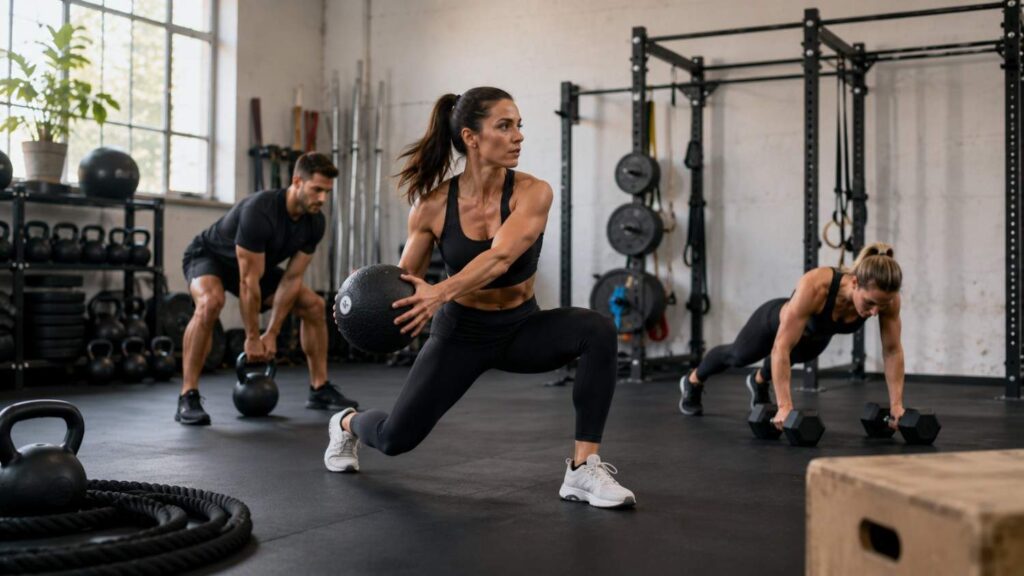
The Benefits of Functional Fitness for Everyday Life
The benefits of functional fitness extend beyond improving appearance, completing a difficult circuit, or lifting more weight in a gym. This training style develops physical qualities used during ordinary life, including standing from a chair, climbing stairs, lifting an object, carrying shopping, reaching overhead, working in the garden, moving on uneven ground, and getting up from the floor.
Functional training usually includes familiar movement patterns such as squatting, hinging, pushing, pulling, carrying, stepping, rotating, reaching, and walking. Exercises can use bodyweight, resistance bands, dumbbells, kettlebells, cables, medicine balls, household objects, or supported positions.
The main advantage is the connection between exercise and capability. Instead of strengthening a muscle without considering how it contributes to a task, functional programming looks at how strength, balance, mobility, coordination, endurance, and confidence work together.
That does not make every traditional exercise inferior. Machine exercises, isolated muscle work, and conventional free-weight training can improve strength and may be useful for muscle growth, rehabilitation, pain management, or addressing a specific weakness. A functional programme can include these methods when they support the intended outcome.
Regular physical activity also provides broader health benefits. CDC guidance recommends that adults generally complete at least 150 minutes of moderate-intensity aerobic activity each week, or an equivalent combination, and perform muscle-strengthening activity on at least two days.
WHO guidance links regular physical activity with physical and mental health benefits, including support for cardiovascular health, brain health, well-being, and the prevention or management of several noncommunicable diseases. These are benefits of physical activity generally rather than proof that any workout carrying the “functional” label is automatically effective.
What Functional Fitness Means in Practice
Functional fitness is exercise designed around meaningful physical outcomes. The programme starts with a task or capability the person wants to improve and then identifies the strength, balance, mobility, coordination, power, and endurance needed to perform it.
For example, standing from a low chair requires leg and hip strength, ankle mobility, trunk control, balance, and confidence. Carrying two heavy bags requires grip strength, shoulder stability, trunk endurance, leg strength, and the ability to walk under load. Climbing stairs requires strength, balance, coordination, and adequate cardiovascular capacity.
An exercise is not functional simply because it looks complicated or uses an unstable surface. The movement should have a clear purpose, match the individual’s current ability, and allow gradual progression.
Functional training also uses the principle of specificity. Improvements are usually greatest in the abilities that are practised. Chair stands may improve confidence and capacity for standing tasks, while step-ups may better prepare someone for stairs. General strength training still matters because stronger muscles create more physical reserve.
For readers who want additional practical examples of functional fitness for daily life, this guide provides easy-to-understand explanations of how functional exercises support everyday movement and long-term mobility.
The table below connects common movement patterns with daily tasks and simple training options.
| Movement Pattern | Daily-Life Example | Functional Exercise |
|---|---|---|
| Squat | Sitting and standing | Chair squat |
| Hip hinge | Lifting from the floor | Dumbbell deadlift |
| Push | Moving a heavy door | Wall or bench push-up |
| Pull | Pulling an object closer | Resistance-band row |
| Carry | Carrying shopping bags | Farmer’s carry |
| Step or lunge | Climbing stairs | Step-up |
| Rotate | Reaching across the body | Controlled cable rotation |
| Balance | Walking on uneven ground | Supported single-leg stand |
The exercise should become more challenging only when the current variation is stable, tolerable, and relevant to the intended goal.
Functional Exercises Use Integrated Movement Patterns
Most real activities require several joints and muscle groups to work together. Lifting a box, for example, may involve the feet, ankles, knees, hips, spine, shoulders, elbows, hands, and breathing muscles.
Functional exercise reflects this coordination through movement patterns such as squatting, hinging, pushing, pulling, stepping, carrying, rotating, and changing direction. These patterns can be trained using bodyweight, resistance bands, free weights, cables, or ordinary objects.
Integrated movement does not mean combining as many actions as possible. A squat-to-press performed while balancing on an unstable device may be more complex, but it is not automatically more useful. Excessive complexity can reduce force production, control, and learning.
Beginners should normally learn the main components separately. A person may first practise a stable squat, then add a light load. Balance work can be trained in a separate supported exercise before both skills are combined.
Isolation exercises also have a place. Calf raises, leg extensions, hamstring curls, grip work, or shoulder exercises may strengthen a weak link. Functional programming is defined by the goal and the complete plan, not by banning exercises that target one muscle.
Related Articles
Functional Fitness Is Different for Every Person
An exercise becomes functional in relation to the person’s needs. The same programme should not be prescribed automatically to an office worker, construction worker, new parent, older adult, and competitive athlete.
An older adult may prioritize chair stands, step-ups, balance, walking, carrying, and safe floor transfers. An office worker may need pulling strength, hip mobility, trunk endurance, and regular movement breaks. A parent may value kneeling, lifting, carrying, and rising from the floor. An athlete may require faster changes of direction, landing control, power, and sport-specific loading.
This individual approach prevents people from copying advanced exercises that do not match their goals. It also helps experienced trainees understand why each movement belongs in the programme.
A useful starting exercise is to write down three activities that currently feel difficult, tiring, or uncertain. The next step is identifying the physical qualities involved. A person who struggles with stairs may need leg strength, balance, and aerobic capacity rather than an advanced upper-body circuit.
Functional training should therefore be planned rather than random. Each exercise needs a reason, a suitable starting level, an appropriate dose, and a progression that moves the person toward a meaningful outcome.
| Functional Movement | Everyday Benefit | Primary Muscles Involved | Beginner-Friendly Option |
|---|---|---|---|
| Squat | Makes sitting and standing easier | Quadriceps, glutes, core | Chair squat |
| Hip Hinge | Improves safe lifting from the floor | Hamstrings, glutes, lower back | Bodyweight hip hinge |
| Push | Helps with pushing doors or objects | Chest, shoulders, triceps | Wall push-up |
| Pull | Supports pulling and lifting tasks | Upper back, biceps | Resistance-band row |
| Carry | Improves carrying groceries or luggage | Grip, core, shoulders | Farmer’s carry with light weights |
| Step-Up | Builds confidence when climbing stairs | Glutes, quadriceps | Low step-up |
| Rotation | Improves reaching and twisting movements | Core, obliques | Standing torso rotation |
| Balance | Supports stability on uneven surfaces | Core, ankles, hips | Single-leg balance hold |
The Benefits of Functional Fitness for Movement and Health
The most direct functional fitness benefits involve physical capability. A well-designed programme may improve muscular strength, mobility, balance, coordination, power, endurance, and confidence during meaningful movements.
The evidence is particularly developed in older populations. A 2026 systematic review and meta-analysis of functional-task training included 12 trials and reported improvements in balance, functional mobility, and walking endurance compared with control conditions. The authors also noted substantial variation between studies for some outcomes, which means the size of benefit may depend on programme design and participant characteristics.
Another 2026 review found that task-oriented training improved balance, gait speed, mobility, and balance confidence compared with conventional training in older adults. However, the evidence for reducing actual fall incidence remained inconclusive.
These findings support functional and task-focused exercise, but they do not prove that one specific workout is best for everyone. The term “functional fitness” covers many different programmes.
Functional exercise may also help people meet broader activity recommendations. A circuit that includes loaded movements and continuous stepping may strengthen muscles and raise heart rate. However, short circuits do not necessarily provide enough aerobic volume by themselves.
The broader health benefits associated with physical activity include better cardiovascular health, improved well-being, support for brain health, stronger bones, and a lower risk of several chronic conditions. Those outcomes depend on regular activity, appropriate intensity, and sufficient weekly volume rather than the functional label alone.
The most effective approach combines functional strength work with suitable aerobic activity, recovery, and progression.
Better Strength, Balance, and Mobility
Functional exercises strengthen the body through patterns used during real activities. Squats and step-ups develop the legs and hips. Rows and presses build upper-body strength. Carries challenge the grip, posture, trunk, and ability to move under load.
Balance improves when postural control is challenged safely. Suitable activities may include supported single-leg standing, heel-to-toe walking, step-ups, reaching within a stable base, and controlled changes of direction.
An overview of systematic reviews found that balance and functional training improved physical functioning and reduced fall rates among adults aged 65 and older, although evidence was limited for younger adult populations.
Mobility is more than passive flexibility. It describes the ability to move through a useful range with control. A functional programme may improve ankle movement for squatting, hip movement for stepping, shoulder movement for reaching, and trunk movement for rotation.
These qualities should be trained together without rushing progression. A person should not add heavy resistance to a position they cannot yet control. Stable exercises normally provide the best foundation.
Meaningful outcomes include easier chair stands, better stair climbing, more comfortable overhead reaching, longer walking tolerance, and improved confidence during balance tasks.
Readers looking to see these concepts applied in real workouts can also explore functional fitness examples that demonstrate how strength, balance, and mobility exercises work together in practice.
Greater Independence During Daily Activities
Functional capacity refers to a person’s ability to complete meaningful physical tasks. This becomes increasingly important with age because reduced strength, balance, power, or endurance can make ordinary activities require a greater percentage of maximum effort.
Current CDC guidance states that physical activity can help older adults maintain independence and quality of life while supporting the prevention or management of chronic disease. Older adults are advised to combine aerobic, strength, and balance activity.
Functional programmes may practise simplified versions of daily tasks. Chair stands support rising from a seated position. Step-ups prepare the legs for stairs and kerbs. Loaded carries develop the ability to transport bags or tools. Controlled floor transfers can support getting down and rising safely.
A randomized trial involving older adults with cognitive impairment found that both resistance exercise and dual-task resistance exercise improved measures of functional fitness and activities of daily living after the intervention, although the dual-task group showed a clearer advantage mainly for cognition.
The purpose is not to make every household task feel like exercise. The goal is to build enough physical reserve that daily activities feel easier, safer, and less exhausting.
More Efficient and Confident Movement
Functional training provides repeated practice with controlled positions, breathing, balance, joint alignment, and force production. Over time, this may improve movement awareness and efficiency.
A person who learns a controlled hip hinge may feel more prepared to lift an object. Someone who practises stepping and balance may feel less uncertain when moving across an uneven surface. Carries can help a person maintain posture while walking with an external load.
Confidence matters because fear or uncertainty can cause people to avoid activity. Reduced activity may then contribute to further losses in strength, endurance, and mobility.
Recent research on task-oriented training in older adults reported improvements in balance confidence as well as gait and balance measures. Evidence for actual fall reduction was less certain, so confidence should be increased alongside appropriate safety rather than through false reassurance.
Functional exercise cannot make someone injury-proof. Injuries and falls are influenced by fatigue, environment, health conditions, previous injury, medication, workload, and unexpected events.
A more accurate goal is better preparation. Stronger muscles, improved balance, useful mobility, and experience handling progressively greater demands can make a person more capable when facing ordinary physical challenges.
How to Start a Safe Functional Fitness Program
A functional fitness programme should begin with exercises the person can perform with reasonable control and confidence. Technique, consistency, and gradual progression matter more than starting with heavy resistance, unstable surfaces, or exhausting circuits.
Begin with the fundamental patterns required for your goals. These may include a squat or chair stand, a hip hinge, a push, a pull, a step, a carry, and a balance activity. Not every person needs every movement in the first session.
Exercise selection should consider current ability. A wall push-up may be more suitable than a floor push-up. A chair squat may be safer and more practical than a deep weighted squat. A supported step-up may be more appropriate than jumping.
General activity guidance recommends that adults complete muscle-strengthening activities for major muscle groups on at least two days each week and accumulate at least 150 minutes of moderate-intensity aerobic activity, or an equivalent amount.
Older adults should also include balance activity. WHO guidance recommends varied multicomponent activity that emphasizes functional balance and strength for older people, particularly as part of maintaining functional capacity and reducing fall risk.
Progress one main variable at a time. Increase repetitions, load, range, distance, time, or movement complexity gradually rather than changing everything together.
People with significant pain, recent surgery, dizziness, unexplained shortness of breath, chronic conditions, disabilities, or concerns about exercise should obtain appropriate professional guidance. A qualified trainer may help with technique and programme design, while medical or rehabilitation concerns require a suitable healthcare professional.
| Training Principle | Why It Matters | Practical Example |
|---|---|---|
| Start with Basic Movements | Builds proper technique before adding difficulty | Chair squat before weighted squat |
| Progress Gradually | Reduces injury risk while improving strength | Increase repetitions before adding weight |
| Train Multiple Movement Patterns | Develops balanced, full-body function | Include squat, push, pull, carry, and balance exercises |
| Focus on Movement Quality | Encourages safe and efficient technique | Perform slow, controlled repetitions |
| Allow Recovery | Supports muscle repair and long-term progress | Schedule 1–2 rest days each week |
| Track Functional Progress | Measures real-world improvements | Record easier stair climbing or longer carry distances |
| Match Training to Daily Needs | Makes workouts more practical and sustainable | Choose exercises based on work, hobbies, or lifestyle |
Begin With Simple Full-Body Movements
A beginner programme can be effective with five or six simple exercises. One example is a chair squat, resistance-band row, wall push-up, low step-up, light carry, and supported balance drill.
The session should begin with a brief warm-up. Comfortable walking, arm movements, ankle mobility, and practice repetitions can prepare the body without creating fatigue.
Beginners may perform one or two controlled sets of each exercise. The exact number of repetitions depends on the movement, load, experience, and health of the person. A set should usually stop before technique deteriorates significantly.
Sessions do not need to be long. A focused 20- to 30-minute routine can build useful capacity when performed consistently. Home-based exercise research in healthy older adults has reported improvements in strength, muscular endurance, power, and balance, including programmes with relatively short sessions.
Special equipment is not required at the beginning. A chair, wall, step, resistance band, or light household object may provide enough challenge.
The exercises should feel purposeful and manageable. Stop the session and seek suitable guidance if exercise causes chest discomfort, faintness, severe dizziness, sharp pain, or unusual breathing difficulty.
Progress Gradually and Measure Practical Results
Progressive overload means increasing the training challenge as the body adapts. In functional fitness, progression involves more than adding heavier weight.
A chair squat can progress through additional repetitions, a slightly lower seat, slower lowering, a greater controlled range, or a light external load. A carry can progress through greater distance, longer duration, added weight, or an uneven load held on one side.
Balance can progress by reducing hand support, narrowing the stance, adding gentle reaching, or practising controlled stepping. Safety support should remain nearby when needed.
Change one major variable at a time. Increasing load, speed, range, and instability together makes it difficult to maintain control or identify why recovery has worsened.
Measure progress in ways connected to the original goal. Useful measures may include controlled chair stands, carry distance, step height, balance time, walking tolerance, push-up variation, or ease of climbing stairs.
Research assessments commonly use tests such as the Timed Up and Go, walking tests, or balance scales, but everyday trainees do not need clinical testing unless a professional considers it appropriate.
The purpose of tracking is to guide decisions. It should show whether meaningful tasks are becoming easier, not simply whether the workout produced exhaustion.
Avoid Common Functional Training Mistakes
One common mistake is assuming that instability always makes an exercise more functional. Standing on an unstable device while lifting may reduce the amount of force a person can produce and increase complexity without improving the target skill.
Another mistake is adding resistance or speed before establishing control. Poor movement does not automatically become better when it is performed faster or under heavier load.
Functional training should not become random high-intensity circuit training. Exercise selection, order, volume, rest, and progression still require planning. A circuit can be useful, but every exercise should support the programme’s goal.
Avoid copying movements simply because they look athletic online. Ask what the exercise develops, whether the risk is reasonable, and how it relates to the intended activity.
Recovery is another important consideration. Repeating demanding squats, hinges, carries, and jumps every day may lead to fatigue that reduces technique and performance. Easier sessions, aerobic activity, mobility work, or rest days can be placed between demanding workouts.
Do not ignore pain or significant changes in ability. A trainer can assist with ordinary exercise technique, but diagnosis and rehabilitation should remain within the scope of qualified healthcare professionals.
The most functional programme is not the most complicated one. It is the one that can be performed safely, progressed logically, and connected clearly with the person’s goals.
Quick Answer About The Benefits of Functional Fitness
The benefits of functional fitness include stronger muscles, improved balance, better mobility, greater coordination, and more confidence when completing everyday tasks. Functional exercise trains movement patterns used in daily life, such as sitting, standing, stepping, lifting, carrying, pushing, pulling, reaching, and changing direction.
Unlike a workout that focuses only on one muscle or machine, functional training often asks several joints and muscle groups to contribute to the same controlled movement. This may improve the way physical qualities work together.
Functional fitness is especially relevant to healthy ageing because strength, balance, gait, and movement confidence contribute to independence. Current reviews of functional-task and task-oriented training in older adults report improvements in outcomes such as balance, walking ability, mobility, endurance, and balance confidence, although programmes and participants differ.
Functional exercise is not one fixed system. The most suitable movements depend on the person’s age, goals, health, experience, work, recreation, and current physical capacity. A beginner may use a chair and wall, while an experienced person may use free weights, cables, or loaded carries.
Functional Fitness Focuses on Real-World Movement
The American College of Sports Medicine describes functional fitness training as a combination of strength, power, mobility, and endurance movements intended to improve physical performance in real-world activities.
The goal is not to copy household tasks exactly. Instead, the programme develops physical qualities that transfer across many activities. Squatting can support sitting and standing. A hip hinge can prepare the body to lift an object from a lower position. Rows and pulling exercises build strength used when moving an object toward the body. Loaded carries challenge grip, posture, trunk control, and walking under resistance.
Daily activities rarely isolate one muscle. Carrying shopping may require leg strength, hand strength, balance, trunk stability, and cardiovascular endurance at the same time. Functional training reflects this by teaching body regions to contribute to a coordinated task.
The exercise must still be appropriate. A movement that is useful for a competitive athlete may be unnecessary for an older beginner. The most functional choice is the one that safely develops a quality needed for a meaningful activity.
It Combines Several Types of Fitness
Functional fitness is broader than resistance training alone. A complete programme may include muscular strength, power, muscular endurance, cardiovascular capacity, balance, coordination, mobility, and controlled changes of direction.
This multicomponent approach is particularly important for older adults. Current CDC recommendations state that adults aged 65 and older should include aerobic, muscle-strengthening, and balance activities each week. The general weekly target includes at least 150 minutes of moderate-intensity aerobic activity, or an equivalent amount of vigorous activity, plus muscle strengthening on at least two days and activities that improve balance.
A functional session might combine controlled chair squats, resistance-band rows, supported step-ups, carries, balance practice, and short periods of walking. Each activity develops a different physical quality, while the session trains the body as an integrated system.
Not every session needs to train every quality. Strength, balance, mobility, and aerobic work can be distributed across the week. Beginners should begin with simple, stable movements and manageable effort. Complexity should increase only when it supports a clear purpose and the current movement can be performed with control.
Frequently Asked Questions
Functional fitness is sometimes described so broadly that almost any exercise can be labelled functional. This creates confusion about muscle growth, beginners, equipment, training frequency, older adults, and the difference between functional and traditional strength training.
The simplest definition is goal-based. Functional exercise develops physical qualities needed for meaningful movement. A chair stand may be highly functional for one person, while a heavy sled push may be relevant to another.
Functional training does not need to replace conventional resistance training. Many effective programmes use squats, presses, rows, deadlifts, carries, machines, and isolated exercises together. The label matters less than the reason each movement is included.
The research base is stronger for certain populations and outcomes than others. Studies in older adults support functional-task, balance, resistance, and multicomponent exercise for outcomes such as physical functioning, mobility, balance, and fall risk. Evidence should not be interpreted as proof that every branded functional workout produces those results.
Training frequency also depends on intensity and programme design. Two or three full-body sessions may be appropriate for many beginners, but the complete week should include suitable aerobic activity and recovery.
The FAQs below provide practical answers while recognizing that individual ability, health, and goals vary. People managing significant pain, chronic disease, disability, recent surgery, or unexplained symptoms should seek appropriate professional advice before following general exercise guidance.
Does Functional Fitness Build Muscle?
Yes. Functional fitness can build muscle when the exercises provide enough resistance, training volume, effort, recovery, and progression.
Squats, hinges, rows, presses, lunges, step-ups, and carries can all create a muscular training stimulus. Bodyweight movements may be enough for beginners, while more experienced trainees usually require additional resistance or harder variations.
However, functional training is not automatically the fastest method for maximizing the size of one specific muscle. Bodybuilding-style programmes often use more direct exercise selection and weekly volume for individual muscle groups.
The two approaches can be combined. A functional programme may include compound movements for coordinated strength and isolated exercises to strengthen a weak muscle or add volume.
Muscle growth depends more on the training dose and progression than on the label attached to the workout. An exercise called functional will not build muscle when it remains too easy.
People seeking muscle growth should monitor resistance, repetitions, sets, effort, nutrition, and recovery while still selecting movements that fit their joints, experience, and goals.
Is Functional Fitness Good for Beginners?
Functional fitness can be an excellent choice for beginners because exercises can be adjusted to the person’s starting ability.
A chair squat can develop the pattern used for sitting and standing. A wall push-up can introduce upper-body pushing. A resistance-band row can train pulling without requiring a heavy machine. Supported balance practice can build confidence before more challenging standing exercises.
Beginners should not start with complicated combinations, maximal effort, heavy loads, or unstable equipment. The first priority is learning controlled movement and establishing a repeatable routine.
Short sessions may be enough initially. Home-based exercise evidence in older adults suggests that even relatively brief, structured programmes can improve physical-fitness outcomes when performed consistently.
A beginner programme should also include rest and suitable aerobic activity. The aim is not to create severe soreness after every workout.
Progress should occur gradually. Repetitions, range, resistance, and complexity can increase when the person demonstrates control and recovers well.
Professional supervision may be useful when the beginner has significant movement limitations, health conditions, pain, or uncertainty about technique.
Is Functional Training Better Than Traditional Strength Training?
Neither approach is always better. The most useful method depends on the goal.
Functional training emphasizes coordinated movement, balance, mobility, and tasks that resemble meaningful activities. Traditional strength training often provides a clear and measurable way to increase force through free weights, machines, or isolated exercises.
A leg-press machine can strengthen the legs even though the movement does not exactly resemble standing from a chair. Stronger legs may still contribute to that task. Chair stands, meanwhile, provide more direct practice of the specific movement.
The two methods can work together. A programme might use a machine to strengthen a weak muscle, free weights for general strength, carries for trunk and grip endurance, and step-ups for stair-related capacity.
The exercise should be judged by its purpose, safety, progress potential, and relevance rather than by whether it looks functional.
Research supports balance and functional training for physical functioning and fall-related outcomes in older adults, but this does not make conventional resistance training unnecessary.
A balanced programme often combines general strength with task-specific practice.
How Often Should I Do Functional Fitness?
Many adults can begin with two or three full-body functional strength sessions each week, allowing recovery between demanding workouts.
Current CDC guidance recommends muscle-strengthening activity on at least two days each week and at least 150 minutes of moderate-intensity aerobic activity, or an equivalent combination of moderate and vigorous activity.
Older adults should also include balance activity. Balance practice may be included within a functional workout or performed in shorter sessions on additional days.
Training frequency depends on intensity, volume, exercise experience, sleep, recovery, and health. A gentle balance or mobility session may be appropriate more frequently than heavy squats or carries.
Beginners should avoid assuming that more sessions always produce faster results. A programme that causes continuous soreness, declining technique, or unusual fatigue may need less volume or greater recovery.
The weekly schedule should also reflect the main objective. Someone training for general health needs aerobic activity as well as strength. An athlete may require more specific practice.
Consistency over several months is more valuable than an unsustainable routine performed every day for one week.
Is Functional Fitness Helpful for Older Adults?
Yes, when the exercises are selected and progressed appropriately.
Older adults benefit from a weekly combination of aerobic, strength, and balance activity. CDC and WHO guidance emphasize multicomponent activity because these qualities support health, physical function, balance, and independence.
Functional exercises can focus on chair stands, step-ups, walking, carrying, reaching, trunk control, and supported balance. These movements relate closely to everyday tasks.
Research reviews report that functional-task and task-oriented training can improve balance, walking, mobility, endurance, and balance confidence in older populations. Evidence for actual fall reduction varies between reviews and should not be overstated.
Exercise should match the person’s health and ability. A stable chair, wall, rail, or trainer may be used for support. Resistance can begin very light.
Older adults with poor mobility, significant fall history, dizziness, neurological conditions, or medical concerns may benefit from assessment by a healthcare or exercise professional.
The goal is not extreme intensity. It is maintaining or improving the ability to move safely and participate in meaningful activities.
Do I Need Special Equipment?
No. Functional training can begin with bodyweight, a stable chair, a wall, stairs, household objects, or resistance bands.
Chair squats, wall push-ups, supported balance exercises, step-ups, and controlled floor movements require little or no specialist equipment. A backpack or shopping bag can sometimes be used for light carrying practice when it is secure and appropriate.
Dumbbells, kettlebells, cables, and medicine balls provide convenient ways to add resistance, but they are tools rather than requirements.
Equipment should be selected because it supports a clear goal. A resistance band may be useful for rows. A dumbbell may make a carry or squat more challenging. A low step may help train stair-related strength.
Avoid purchasing unstable devices simply because they are marketed as functional. Instability can be useful in selected balance exercises, but it may be unnecessary or unsafe for loaded strength work.
The most important requirements are enough clear space, stable support where needed, and a progression that matches the person’s ability.
Beginners may gain substantial benefits from simple equipment when exercises are performed consistently and become gradually more challenging.
Conclusion
The benefits of functional fitness come from developing physical qualities that support meaningful movement. Strength, balance, mobility, endurance, power, coordination, and trunk control all contribute to the ability to complete everyday tasks.
A functional programme should reflect the individual’s life. One person may use chair stands to support independence, while another uses carries for work, shopping, sport, or parenting. Step-ups may prepare someone for stairs, and controlled rotations may support reaching or recreational activity.
Functional fitness is not a special collection of complicated exercises. Basic squats, hinges, rows, presses, carries, step-ups, walking drills, and balance exercises can be highly functional when selected for a clear purpose.
Traditional resistance training can remain part of the plan. Machines, free weights, and isolated exercises may strengthen muscles that contribute to a larger movement.
The wider health benefits associated with exercise come from regular physical activity. Functional strength work should be combined with suitable aerobic activity, recovery, sleep, and other supportive habits.
Beginners should start with stable, manageable movements. Older adults and people with health conditions should use suitable modifications and seek professional advice when necessary.
Research is particularly supportive of functional-task, balance, resistance, and multicomponent exercise for older adults, with reported improvements in mobility, balance, walking, endurance, and aspects of independence. The evidence does not mean every functional workout will produce the same results.
When applied thoughtfully, functional fitness can make daily movement feel more manageable and help people maintain physical capacity over time.
The Main Benefits to Remember
Functional fitness can support strength for lifting, carrying, pushing, and pulling. It can develop balance for standing, stepping, and changing direction. It may improve mobility for reaching and moving through useful ranges.
Functional exercise can also develop coordination between muscles and joints, muscular endurance for repeated tasks, and confidence during meaningful physical activity.
These outcomes require consistency. One difficult workout will not create lasting functional capacity. Improvements occur through appropriate exercises, manageable training volume, recovery, and progressive challenge.
A balanced routine should include fundamental movement patterns, strength for major muscle groups, aerobic activity, and balance work where relevant.
The most useful measure of progress is whether meaningful activities become easier. This may include standing from a chair, carrying shopping, climbing stairs, gardening, working, playing with children, or participating in recreation.
Not every benefit needs to be measured with a complex test. Increased confidence, reduced effort during daily tasks, and greater willingness to be active can also be valuable signs.
The programme should remain specific to the individual rather than following a generic definition of what functional movement should look like.
Your Best Next Action
Choose three everyday activities you want to perform more comfortably or confidently. Write down the movement patterns and physical qualities involved.
For example:
- Standing from a chair may require squatting strength and balance.
- Carrying shopping may require grip, trunk stability, and walking endurance.
- Climbing stairs may require leg strength, balance, and cardiovascular capacity.
Select one simple exercise for each need. A chair squat, farmer’s carry, and low step-up could form the foundation of a short routine.
Perform the exercises two or three times each week with manageable resistance. Record repetitions, load, distance, balance time, or another practical measurement.
Increase the challenge gradually. Add repetitions first, then consider resistance, range, distance, or a harder variation when appropriate.
Combine functional strength training with walking, cycling, swimming, or another suitable form of aerobic activity.
The plan does not need to be complicated. A small number of well-selected exercises, performed consistently and progressed over time, may provide more value than a constantly changing routine with no clear objective.
