
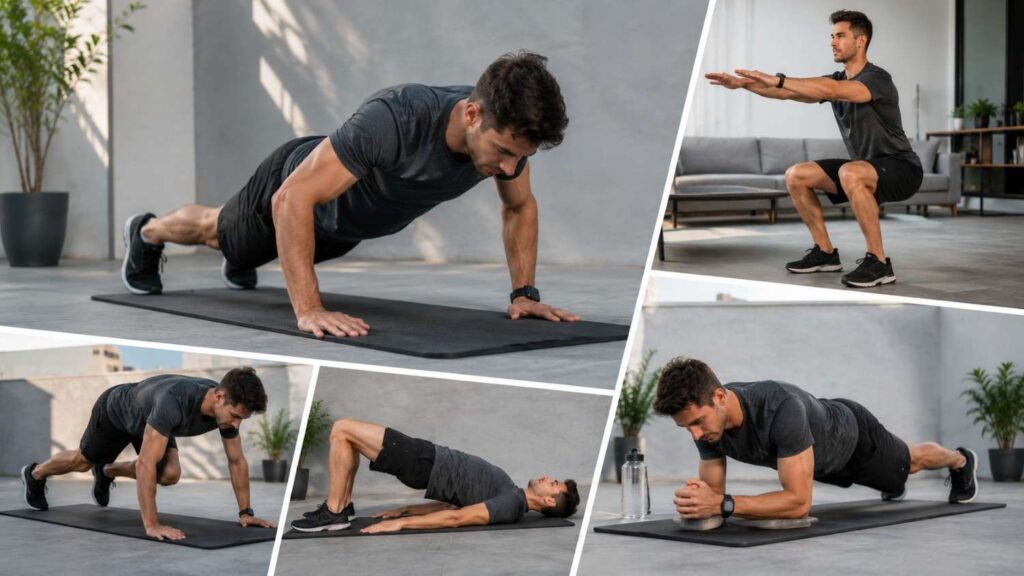
How to Use Bodyweight Exercises for Full-Body Workouts
Learning how to use bodyweight exercises for full-body workouts gives you a practical and flexible way to improve strength, mobility, balance, coordination, and muscular endurance. Unlike training plans that depend on machines, dumbbells, or a fully equipped gym, bodyweight training uses your own body as resistance. This makes it suitable for home workouts, outdoor sessions, hotel-room exercise, and busy days when travelling to a fitness facility is not convenient.
A well-designed bodyweight workout can train nearly every major muscle group. Squats and lunges develop the legs and hips, push-ups strengthen the chest, shoulders, and arms, while bridges and hip-hinge movements target the glutes and posterior chain. Planks, bird dogs, and dead bugs improve core stability, and carefully selected conditioning movements can raise the heart rate while increasing muscular endurance.
Bodyweight training is also a recognised form of resistance exercise. The Centers for Disease Control and Prevention recommends that adults perform muscle-strengthening activities involving all major muscle groups on at least two days per week. Bodyweight movements can help meet this recommendation when they are performed with suitable intensity, proper form, and consistent progression.
The key is not to perform random exercises as quickly as possible. An effective routine should include balanced movement patterns, appropriate exercise variations, controlled repetitions, planned rest periods, and a clear method for increasing difficulty over time. When these elements are combined, bodyweight exercises can support beginners who are building a fitness foundation and experienced exercisers who want a challenging full-body workout without relying heavily on equipment.
Why Bodyweight Exercises Work for Full-Body Fitness
Bodyweight exercises are effective because they require the muscles to produce force while also controlling posture, balance, and joint position. Although external weights are not always used, the body still works against gravity and leverage. Changing the angle of an exercise, the position of the limbs, the speed of movement, or the amount of support can significantly increase or decrease resistance. This adaptability makes bodyweight training suitable for a wide range of fitness levels.
A major advantage of bodyweight training is that many exercises involve several muscle groups at the same time. Squats engage the thighs, glutes, calves, and core, while push-ups challenge the chest, shoulders, triceps, and stabilising muscles around the trunk. This multi-muscle involvement allows a relatively small number of movements to create a comprehensive full-body session.
Bodyweight exercises also help develop movement quality. Because the body is not fixed into a machine, the exerciser must control balance, alignment, and range of motion. This can improve awareness of how the hips, knees, shoulders, spine, and ankles move during exercise and everyday activities.
However, effective results still depend on proper programming. Repeating easy exercises without increasing the challenge may eventually stop producing improvement. Similarly, performing only favourite movements can create an unbalanced routine. For bodyweight training to support full-body fitness, it should include a variety of movement patterns, adequate resistance, planned recovery, and progressive difficulty.
They Train Multiple Muscle Groups Together
Many bodyweight movements are compound exercises, meaning they involve more than one joint and several muscle groups. A push-up is commonly described as a chest exercise, but it also requires the shoulders and triceps to produce force while the abdominal muscles, glutes, and legs maintain a stable body position. Similarly, a lunge trains the quadriceps and glutes while also challenging balance, ankle stability, and trunk control.
This combination makes bodyweight exercises useful for building functional strength. Functional strength refers to the ability to produce and control force during activities such as standing up, climbing stairs, lifting objects, maintaining posture, or changing direction. Although exercise does not need to copy daily life exactly, movements that require the body to work as a coordinated unit can improve overall control and physical confidence.
Compound exercises also make workouts more time-efficient. Instead of performing a separate exercise for every small muscle, you can use several well-chosen movements to train the major areas of the body. A circuit containing squats, push-ups, lunges, rows, glute bridges, and planks can provide broad muscular coverage in a relatively short session.
Balance remains important, however. A routine that contains several pushing exercises but no pulling or upper-back work may become incomplete. Exercise selection should therefore reflect the entire body rather than only the most familiar or convenient muscles.
They Remove Common Workout Barriers
One of the main reasons people struggle to exercise consistently is that their routine depends on conditions that are not always available. Gym travel, membership costs, limited opening hours, crowded equipment, work demands, childcare, and unpredictable schedules can all interrupt a training plan. Bodyweight exercises reduce many of these barriers because they require little space and can often be performed without specialist equipment.
A full-body workout without equipment can be completed in a bedroom, living room, garden, office, park, or hotel. The session can also be adjusted to fit the time available. A person with only 15 minutes can perform two focused circuits, while someone with more time can add an extended warm-up, additional sets, mobility work, or conditioning.
The American College of Sports Medicine has highlighted that resistance training does not need to depend on traditional gym machines or heavy free weights. Home-based routines, resistance bands, and bodyweight exercises can improve strength and physical function when the training is sufficiently challenging and performed consistently.
Convenience should not be confused with simplicity or lack of difficulty. Movements such as single-leg squats, decline push-ups, pike push-ups, and advanced plank variations can be highly demanding. The main advantage is that the routine can progress without requiring constant access to a gym, making long-term consistency easier to maintain.
How to Build a Balanced Bodyweight Full-Body Workout
Building a balanced bodyweight full-body workout begins with understanding movement patterns rather than creating a long list of unrelated exercises. Each exercise should have a clear purpose and contribute to overall muscular balance. The routine should train the lower body, upper body, posterior chain, and core while including both strength and controlled conditioning where appropriate.
Start by considering which major movements the body needs to perform. Squatting and lunging strengthen the legs and hips, pushing develops the chest, shoulders, and triceps, while pulling movements train the back and biceps. Hip-extension exercises activate the glutes and hamstrings, and core-stability movements help the trunk resist unwanted bending or rotation.
The next step is to choose exercise variations that match current ability. A movement should be challenging enough that the final repetitions require effort, but not so difficult that posture, breathing, or joint alignment breaks down. Beginners may need elevated or supported variations, while advanced exercisers can increase leverage, range of motion, tempo, or single-limb loading.
Workout organisation also matters. Large compound exercises should generally appear before smaller or less demanding movements. Alternating upper- and lower-body exercises can reduce local fatigue and help the workout flow efficiently.
Finally, decide how many sets, repetitions, and rest periods are appropriate. The goal is to create enough training stimulus to encourage improvement without producing excessive fatigue that prevents proper recovery or makes the routine difficult to repeat consistently.
Cover the Main Movement Patterns
A complete routine should normally include exercises from several fundamental movement categories. The first is the squat pattern, which includes chair squats, bodyweight squats, and split squats. These movements primarily train the quadriceps and glutes while also requiring ankle mobility and trunk control. Lunges provide a related but more unilateral challenge because each leg must work more independently.
The push pattern includes wall push-ups, incline push-ups, floor push-ups, and pike push-ups. These exercises train the chest, shoulders, and triceps. Pulling movements are more difficult to perform without equipment, but they remain important for upper-back development. Safe options may include resistance-band rows, suspension rows, or inverted rows using equipment specifically designed to support body weight.
Hip-extension movements such as glute bridges, single-leg bridges, and controlled hip hinges strengthen the glutes and hamstrings. These exercises complement squat-based movements and help prevent a routine from becoming overly focused on the front of the thighs.
Core training should include stability-based movements such as planks, side planks, dead bugs, and bird dogs. Conditioning movements, including marching, mountain climbers, step jacks, or high knees, can be added after the primary strength exercises. Covering these patterns creates a more complete workout and reduces the chance of neglecting important muscle groups.
Choose Appropriate Sets, Repetitions, and Rest
Sets and repetitions should be selected according to exercise difficulty, fitness level, and training goal. Beginners can usually start with one or two sets of each exercise and gradually progress to three sets. A repetition range of 8–15 works well for many bodyweight strength movements, provided the final repetitions feel challenging without causing technique to deteriorate.
Some exercises are better measured by time. Planks, wall sits, mountain climbers, and marching variations may be performed for 20–40 seconds. Time-based sets can simplify circuit training, but they should not encourage rushing. A slower, controlled movement often creates more muscular tension than completing as many repetitions as possible.
Rest periods also influence workout quality. During a general full-body circuit, 30–60 seconds between exercises may be sufficient. Resting for one or two minutes between complete rounds can help restore breathing and muscular control. Harder strength-focused movements may require longer recovery, particularly when training close to muscular fatigue.
You do not need to perform every set until complete failure. Stopping when only one or two technically sound repetitions appear possible can provide a strong training stimulus while reducing unnecessary breakdown in form. Rest should be long enough to maintain exercise quality. Shortening rest merely to make the workout feel more intense may reduce strength performance and encourage careless movement.
Arrange Exercises in a Logical Order
Exercise order affects performance because fatigue develops throughout the session. The most technically demanding or physically challenging movements should usually be completed early, when concentration and energy levels are highest. This may include split squats, floor push-ups, single-leg exercises, or difficult rowing variations.
A useful strategy is to alternate lower- and upper-body movements. For example, perform squats first, followed by push-ups, reverse lunges, rows, glute bridges, and then a plank. While the upper body works, the legs receive partial recovery, and while the lower body works, the pressing muscles can rest. This structure makes the session efficient without forcing the same muscle group to work repeatedly with minimal recovery.
Core and conditioning exercises generally fit well near the end of the circuit. However, if core stability is a major weakness, a low-fatigue activation exercise such as a dead bug or bird dog can be included earlier. Avoid exhausting the abdominal muscles before difficult compound movements because a fatigued core may reduce posture and control.
The final order should also consider personal priorities. Someone focused on improving push-ups may place them first, while a person working on lower-body strength may begin with squats or lunges. The session should remain balanced, but the highest-priority movement can receive attention before fatigue limits performance.
Best Bodyweight Exercises for Each Major Muscle Group
The best bodyweight exercises are not automatically the most advanced or visually impressive movements. An exercise is valuable when it challenges the intended muscles, allows controlled technique, fits the individual’s mobility, and can be progressed over time. A basic squat performed through a comfortable range with stable alignment may be more useful than an unstable single-leg variation performed with poor control.
Exercise selection should also consider the relationship between muscle groups. Many popular home workouts contain a large number of squats, lunges, crunches, and push-ups but provide limited work for the upper back, hamstrings, or glutes. A more balanced routine includes lower-body knee-dominant exercises, hip-dominant exercises, pushing, pulling, core stability, and optional conditioning.
Beginners should begin with variations that build confidence and movement awareness. Using a chair, wall, countertop, or stable elevated surface can reduce the resistance while preserving the basic movement pattern. As strength improves, the exercise can be progressed gradually.
Advanced exercisers do not always need completely different exercises. Increasing range of motion, slowing the eccentric phase, adding pauses, using unilateral variations, or changing body angle can make familiar movements significantly harder. The objective is to choose exercises that can be performed safely, measured clearly, and progressed consistently.
The following categories provide a foundation for a complete bodyweight strength-training routine that can be adjusted for home, outdoor, or travel-based workouts.
| Exercise Category | Primary Muscles Targeted | Main Benefits | Beginner-Friendly |
|---|---|---|---|
| Squats | Quadriceps, Glutes, Core | Builds lower-body strength and balance | ✅ Yes |
| Lunges | Legs, Glutes, Core | Improves stability and coordination | ✅ Yes |
| Push-Ups | Chest, Shoulders, Triceps | Develops upper-body strength | ✅ Yes (Wall/Incline) |
| Glute Bridges | Glutes, Hamstrings | Strengthens the posterior chain | ✅ Yes |
| Planks | Core, Shoulders | Improves core stability and posture | ✅ Yes |
| Bird Dogs | Core, Lower Back | Enhances balance and spinal control | ✅ Yes |
| Mountain Climbers | Full Body | Boosts cardiovascular endurance | ✅ Yes (Slow Variation) |
Lower-Body Exercises
Bodyweight squats are one of the most accessible lower-body exercises. They primarily train the quadriceps and glutes while also involving the calves, adductors, and trunk. Beginners can use a chair squat by sitting back toward a stable chair and standing again with control. As confidence improves, the chair can be removed, depth can be increased, or a slower lowering phase can be introduced.
Lunges and split squats train the legs more independently than traditional squats. Reverse lunges are often easier to control because the body remains more stable as the working leg stays in front. People who struggle with balance can hold a wall, chair, or secure support. More advanced options include walking lunges, deficit reverse lunges, Bulgarian split squats, and assisted single-leg squats.
Glute bridges strengthen the glutes and introduce the hip-extension pattern. They are particularly useful in routines that contain several squat and lunge movements because they shift more emphasis toward the back of the hips. Progressions include longer pauses at the top, feet-elevated bridges, marching bridges, and single-leg bridges.
During lower-body exercises, maintain stable foot contact and allow the knees to travel in the same general direction as the toes. Exercise depth should be based on control, comfort, and mobility rather than forcing an arbitrary position.
Upper-Body Exercises
Push-ups are among the most adaptable bodyweight exercises for the upper body. Wall push-ups provide a suitable entry point for beginners, while incline push-ups performed against a countertop, bench, or secure elevated surface gradually increase resistance. Floor push-ups demand more upper-body strength and greater core stability because a larger percentage of body weight must be supported.
Good push-up technique involves maintaining a stable line from the head through the hips, controlling the lowering phase, and allowing the elbows to move at a comfortable angle rather than flaring sharply outward. The chest should move toward the support while the trunk remains firm. If the hips drop or the shoulders become uncomfortable, the exercise variation may be too difficult.
More advanced options include close-grip push-ups, pause push-ups, decline push-ups, archer push-ups, and tempo repetitions. Pike push-ups place greater emphasis on the shoulders and can act as a progression toward more advanced overhead pressing patterns.
Upper-body training should also include pulling. Resistance-band rows, suspension rows, and properly performed inverted rows help train the upper back and biceps. Any supporting equipment must be stable and designed for exercise. Improvised furniture or unsecured objects should not be used when there is a risk of slipping, tipping, or structural failure.
Core and Conditioning Exercises
Core training should focus on controlling the position of the spine and pelvis rather than performing endless rapid abdominal repetitions. A plank teaches the body to resist extension, while a side plank challenges lateral stability. Dead bugs and bird dogs develop control through opposite-arm and opposite-leg movement, making them useful for beginners and advanced exercisers who want to improve coordination.
The quality of core exercises depends on maintaining tension and breathing normally. During a plank, avoid allowing the lower back to sag or the hips to rise excessively. During a dead bug, keep the lower back controlled as the limbs move. If the position cannot be maintained, reduce the range of motion or use an easier variation.
Conditioning exercises can be added to increase heart rate and muscular endurance. Mountain climbers, step jacks, marching, high knees, squat-to-reach movements, and controlled burpee variations are common choices. Jumping is not required. Low-impact options can still provide a meaningful cardiovascular challenge when performed continuously and with purposeful arm movement.
The conditioning exercise should not compromise the strength portion of the routine. Place it near the end of the circuit or use short intervals. Choose a variation that allows steady breathing, stable landings, and consistent technique throughout the working period.
Sample 30-Minute Full-Body Workout Without Equipment
A 30-minute bodyweight workout can provide a complete training session when the time is organised carefully. The goal is not to fit as many exercises as possible into the available period. Instead, divide the session into a purposeful warm-up, a balanced full-body circuit, and a gradual cool-down. This structure improves exercise quality and helps the body transition safely into and out of more demanding movement.
The workout below is suitable for many beginners and can be adjusted for intermediate exercisers. Each movement includes easier and harder options, allowing the same routine to remain useful as strength improves. Beginners may complete two rounds, while more experienced participants can complete three rounds or use more difficult variations.
Perform each exercise with control rather than racing against the clock. Take approximately 30–45 seconds of rest between exercises when needed and one or two minutes between complete rounds. People with lower fitness levels may need longer recovery, while experienced exercisers may use shorter breaks without sacrificing technique.
Before starting, clear the workout area and ensure the floor is not slippery. Any chair, wall, countertop, or elevated surface used for support should be stable. Keep water nearby and stop the session if unusual pain, dizziness, chest discomfort, or severe shortness of breath occurs.
This workout can be performed two or three times per week. Progress by improving technique, adding repetitions, completing an additional round, or selecting a harder variation rather than increasing every training variable at once.
Complete a Dynamic Warm-Up
Begin with five to ten minutes of gradual movement. The warm-up should increase body temperature, prepare the joints, and rehearse the movement patterns that will appear in the main workout. It should not be so difficult that the muscles feel tired before the first working set begins.
Start with one or two minutes of marching in place. Allow the arms to swing naturally and gradually increase the height of the knees. Follow this with arm circles, shoulder rolls, and controlled torso rotations to prepare the upper body. Hip hinges, shallow squats, and alternating knee lifts can then introduce the lower-body patterns used later.
Include several slow wall push-ups or incline push-ups to prepare the shoulders, chest, and arms. Supported reverse lunges can help warm the hips and knees while allowing balance to develop gradually. Finish with a few controlled glute bridges or standing hip extensions to activate the posterior chain.
The American Heart Association recommends warming up before exercise so that heart rate and breathing increase progressively rather than suddenly. A proper warm-up also provides an opportunity to assess how the body feels that day. If a movement causes unusual discomfort, reduce the range, change the exercise, or avoid that variation during the main session.
Perform the Full-Body Circuit
Complete the following exercises in sequence. Beginners can perform two rounds, while intermediate exercisers can complete three rounds. Rest whenever necessary to maintain controlled breathing and proper alignment.
| Exercise | Beginner Target | Easier Option | Harder Option |
|---|---|---|---|
| Bodyweight squat | 10–15 repetitions | Chair squat | Tempo or jump squat |
| Incline push-up | 8–12 repetitions | Wall push-up | Floor or decline push-up |
| Reverse lunge | 6–10 per side | Supported split squat | Walking or deficit lunge |
| Glute bridge | 12–15 repetitions | Short-range bridge | Single-leg bridge |
| Bird dog | 8 per side | Move one limb at a time | Add a longer pause |
| Mountain climber | 20–30 seconds | Elevated slow climber | Faster floor climber |
| Forearm plank | 15–30 seconds | Elevated plank | Shoulder-tap plank |
Move slowly enough to feel the intended muscles working. During squats and lunges, maintain stable foot contact and avoid collapsing inward at the knees. During push-ups, keep the trunk firm and choose an elevation that allows complete, controlled repetitions.
The final exercises should still look similar to the first. If technique declines significantly, reduce the number of repetitions, extend the rest period, or stop the round. Completing fewer high-quality repetitions provides more benefit than continuing with uncontrolled movement simply to finish the planned target.
Cool Down Gradually
After the final circuit, avoid stopping suddenly and immediately sitting or lying down. Begin the cool-down with two or three minutes of slow walking or gentle marching. Allow the breathing rate to decrease gradually while relaxing the shoulders and arms. This transition can feel more comfortable than moving directly from intense exercise to complete rest.
Once breathing has settled, perform gentle mobility or stretching movements for the muscle groups used during the workout. A standing quadriceps stretch can target the front of the thighs, while a calf stretch against a wall may relieve tension in the lower legs. A gentle chest stretch, shoulder stretch, and kneeling hip-flexor stretch can also be included.
Hold each comfortable stretch for approximately 15–30 seconds without bouncing or forcing the joint into an extreme position. Stretching should create mild tension, not sharp pain. People with balance concerns can use a wall or stable chair for support.
The cool-down is also a useful time to evaluate the session. Note which exercises felt manageable, which became difficult, and whether any movement caused discomfort. This information can guide the next workout. Progress may involve increasing a repetition target, but it may also mean improving control, balance, breathing, or range of motion.
How to Make Bodyweight Exercises More Challenging
Bodyweight exercises must become progressively more demanding if they are expected to continue improving strength, muscular endurance, or muscle development. The body adapts to repeated training. An exercise that once required considerable effort may eventually become easy because the nervous system, muscles, and movement technique have improved.
Progression does not always require adding external weight. Resistance can be increased by changing leverage, reducing support, increasing range of motion, slowing the movement, adding pauses, or using one limb instead of two. These methods allow basic exercises to remain effective for a long time.
However, progression should be gradual and measurable. Changing several variables at once may make the workout unnecessarily difficult and prevent you from identifying what produced the improvement or caused discomfort. A better approach is to adjust one factor, maintain it for several sessions, and observe the response.
For example, someone performing incline push-ups could first increase from eight to twelve repetitions. Once twelve controlled repetitions are manageable, the support surface could be lowered slightly. The repetition target may then return to eight before increasing again.
Advanced exercisers should also avoid assuming that harder variations are automatically better. A complex movement performed with limited range and unstable alignment may create less useful muscular tension than a simpler exercise performed slowly and precisely. Progression should preserve or improve technique rather than sacrificing control simply to perform a more impressive variation.
| Progression Method | How It Increases Difficulty | Best For |
|---|---|---|
| Increase Repetitions | Performs more quality reps | Beginners |
| Add More Sets | Increases total training volume | All Fitness Levels |
| Slow Down Tempo | Creates more time under tension | Strength & Muscle Growth |
| Pause During Movement | Improves muscular control and stability | Intermediate Users |
| Increase Range of Motion | Makes muscles work through a larger movement | Mobility & Strength |
| Single-Limb Variations | Places more load on one side of the body | Advanced Users |
| Reduce Rest Time | Increases workout intensity and endurance | Conditioning |
Apply Progressive Overload Without Weights
Progressive overload means gradually increasing the demand placed on the muscles. With bodyweight training, the simplest method is to add repetitions. If you currently perform eight controlled squats, aim for nine or ten during a later session. Once the upper end of the target range becomes comfortable, increase the exercise difficulty.
Adding a set is another effective method. Moving from two rounds to three increases total training volume without changing the exercise itself. Tempo can also be adjusted. Lowering into a squat or push-up for three or four seconds creates more time under tension and reduces the ability to rely on momentum.
Pauses increase difficulty by removing the stretch-shortening effect and requiring the muscles to maintain tension. Pausing near the bottom of a push-up, split squat, or glute bridge can make the movement more demanding without adding repetitions. Greater range of motion may also increase the challenge when the joints can move comfortably and safely.
Unilateral variations place more resistance on one limb. A single-leg bridge is harder than a two-leg bridge, and a split squat places greater emphasis on each leg than a standard squat. Rest periods may also be shortened, although this method primarily increases fatigue and conditioning demand. Use it carefully when strength and technique are the main priorities.
Track Performance and Technique
Tracking workouts helps convert exercise from a random activity into a structured training process. Record the exercise variation, number of sets, repetitions, working time, and approximate rest period. A notebook, spreadsheet, or simple phone note is sufficient. The tracking method should be easy enough to use consistently.
Include a brief rating of exercise difficulty. For example, use a scale from one to ten, where one feels extremely easy and ten represents maximum effort. A set that feels like seven or eight may indicate that only two or three technically sound repetitions remain possible. This information can help determine when to progress.
Technique improvements should also be considered progress. A deeper squat performed with stable alignment, a push-up completed with a firmer trunk, or a longer plank maintained without lower-back sagging may be more meaningful than adding several rushed repetitions. Video recording can help identify posture issues, provided the camera is positioned safely and does not interrupt the workout.
Record pain or unusual discomfort separately from normal muscular effort. Burning in a working muscle and general fatigue are different from sharp, sudden, or worsening joint pain. If a movement repeatedly causes pain, stop using that variation and seek guidance from an appropriate healthcare or fitness professional instead of continuing to increase the workload.
How Often Should You Perform Bodyweight Workouts?
Workout frequency should reflect the difficulty of the sessions, current fitness level, recovery ability, sleep quality, stress, and other physical activities. Performing bodyweight exercises every day is not automatically harmful, but intense full-body strength sessions usually require recovery between workouts. Muscles, joints, and the nervous system need time to adapt to the training stimulus.
For most beginners, two full-body sessions per week provide an effective starting point. These workouts can be placed on nonconsecutive days, such as Monday and Thursday, allowing several days of recovery. As fitness improves, a third session may be added if soreness remains manageable and performance does not decline.
Intermediate and advanced exercisers may train more frequently by adjusting workout intensity or dividing the training focus. One session may be challenging, another moderate, and a third lighter. Alternatively, different movement patterns can receive greater emphasis on different days while the overall programme remains balanced.
Frequency should not be considered separately from volume. Three short sessions may create a similar weekly workload to two longer sessions. A person who performs several demanding sets per exercise may need more recovery than someone completing a brief technique-focused circuit.
Other activities also matter. Running, cycling, sports, physical labour, and long periods of walking can influence lower-body recovery. The best schedule is one that produces gradual improvement without persistent soreness, fatigue, declining performance, disrupted sleep, or loss of motivation.
Beginner Weekly Schedule
A beginner can start with two nonconsecutive full-body workouts each week. This schedule provides regular practice while allowing enough time to recover and learn proper movement patterns. The CDC recommends muscle-strengthening activity for all major muscle groups on at least two days per week, making this a practical minimum target.
A simple schedule may include a full-body workout on Monday and Thursday. Tuesday can include light walking or gentle mobility, while Wednesday is used for rest. Friday may involve another low-intensity aerobic activity, and the weekend can include recreational movement or additional recovery.
The first sessions should be moderate rather than exhausting. Complete one or two sets of each movement and stop before technique fails. Beginners often experience muscle soreness when starting a new routine, but the soreness should gradually improve as the body adapts. Severe or persistent pain is not required for progress.
After several weeks, review the training response. If exercises are becoming easier, recovery is comfortable, and motivation remains high, add a third weekly session or increase the workload slightly. Avoid increasing frequency, sets, repetitions, and exercise difficulty simultaneously.
Consistency is the main objective during the beginner stage. A manageable routine performed for several months is more effective than an aggressive schedule that causes excessive fatigue and is abandoned after a few weeks.
Intermediate Weekly Schedule
Intermediate exercisers may perform three or four bodyweight training sessions per week, depending on workout volume and intensity. Full-body sessions can still be used, but each workout does not need to be equally demanding. Varying the emphasis can help maintain performance while controlling fatigue.
For example, Monday may focus on strength with slower squats, challenging push-ups, rows, and longer rest periods. Wednesday can use moderate variations and slightly higher repetitions. Friday may emphasise unilateral leg work, shoulder-focused pushing, glute exercises, and core stability. An optional weekend session can include mobility, easier conditioning, or skill practice.
Another approach is to alternate Workout A and Workout B. Workout A may include squats, push-ups, rows, and planks, while Workout B includes lunges, pike push-ups, glute bridges, side planks, and conditioning. Both routines remain full-body workouts, but the repeated movements and emphasis change.
Intermediate exercisers should monitor performance carefully. If repetition numbers fall across several sessions, joints feel increasingly irritated, or motivation declines, total volume may be too high. Reducing one session, using easier variations, or scheduling a lighter week can improve recovery.
More training is only beneficial when the body can adapt to it. The objective is to distribute quality work across the week, not to accumulate fatigue simply because bodyweight exercises are available every day.
Common Bodyweight Training Mistakes to Avoid
Bodyweight exercises are accessible, but they are not automatically risk-free or effective. Poor exercise selection, excessive volume, inadequate progression, and careless technique can limit results. Many people make the mistake of treating a bodyweight workout as a test of speed or exhaustion rather than a structured form of resistance training.
One common problem is performing the same easy routine for months. Repetition can improve familiarity, but the muscles eventually need a greater challenge. Without progression, the workout may maintain current ability rather than producing continued improvement. The opposite mistake is progressing too quickly and selecting advanced exercises before basic movement control has been developed.
Another issue is imbalance. Home workouts often contain several pressing and knee-dominant exercises but little pulling, hip extension, or upper-back work. This does not make push-ups or squats harmful, but the routine should include movements that train complementary areas.
Rest and recovery are also frequently overlooked. Because no heavy equipment is used, people may assume they can perform demanding sessions every day. High-repetition lunges, push-ups, jump squats, and burpees can still create substantial muscular and joint stress.
A well-planned programme should feel challenging while remaining repeatable. Pain, persistent fatigue, declining technique, or worsening performance should not be ignored. Adjusting the routine is a sign of intelligent training, not a lack of commitment.
Doing Too Much Too Soon
Beginners often select workouts designed for advanced exercisers because the movements appear familiar. A circuit containing high-volume burpees, jump lunges, floor push-ups, and long planks may look simple on paper, but the combined workload can be excessive for someone without a training foundation.
Rapid increases in repetitions, rounds, frequency, or exercise complexity can lead to severe soreness, irritated joints, poor technique, and loss of motivation. Instead of trying to prove fitness during the first session, begin with variations that can be controlled. Wall push-ups, chair squats, supported lunges, and elevated planks allow the same movement patterns to be practised with less resistance.
Progress only one or two variables at a time. If the number of repetitions increases, keep the exercise variation and number of sets consistent. If a harder variation is introduced, reduce the repetition target temporarily. This approach allows the body to adapt and makes it easier to identify which change caused excessive fatigue or discomfort.
Sudden training increases are a recognised contributor to overuse problems. A gradual programme may feel less dramatic, but it produces a stronger long-term foundation. The objective is to finish the workout feeling challenged yet capable of recovering and returning for the next planned session.
Ignoring Pulling, Recovery, or Pain
Many no-equipment workouts include several versions of push-ups but provide no pulling exercises. Over time, this may create an unbalanced programme that neglects the upper back and biceps. When possible, include resistance-band rows, suspension rows, or inverted rows using stable, purpose-built equipment. Pulling work should be treated as a core part of full-body training rather than an optional extra.
Recovery is equally important. Muscles adapt between workouts, not only during them. Persistent soreness, declining exercise performance, unusual fatigue, sleep disruption, and reduced motivation may indicate that training volume or frequency should be reduced. Light movement can support recovery, but another intense workout is not always the best response.
Pain should not be treated as proof that the exercise is effective. Normal muscular effort may include burning, fatigue, or mild soreness, but sharp, sudden, localised, or worsening pain requires attention. Stop the movement, check technique, and use an easier or different variation.
Seek appropriate medical attention if exercise produces chest pain, faintness, severe dizziness, irregular heartbeat, unusual breathing difficulty, or nausea. People with chronic health conditions, recent surgery, pregnancy-related concerns, or significant injuries should obtain personalised guidance before beginning or intensifying a workout programme.
Quick Answer About How to Use Bodyweight Exercises for Full-Body Workouts
To use bodyweight exercises for a complete full-body workout, begin by selecting movements that cover the major functions of the body rather than choosing exercises randomly. A balanced routine should usually include a squat, lunge, push, pull where possible, hip-extension movement, core-stability exercise, and a controlled cardiovascular movement. This structure helps ensure that the legs, hips, chest, shoulders, arms, back, and abdominal muscles all receive attention during the session.
Beginners can select five to seven exercises and perform 8–15 controlled repetitions of each movement. Time-based sets lasting 20–40 seconds can also work well, particularly for planks, mountain climbers, or marching exercises. Complete the selected exercises in sequence, rest for approximately one or two minutes, and repeat the circuit two or three times depending on fitness level and available time.
Exercise difficulty should match current ability. Wall or incline push-ups may be more appropriate than floor push-ups for beginners, while chair squats can help people learn proper lower-body mechanics. More advanced exercisers can use slower tempos, pauses, single-limb variations, deeper ranges of motion, or more difficult movement angles.
Most importantly, prioritise form and consistency. Perform full-body bodyweight workouts two or three times per week, allow sufficient recovery, and gradually increase the challenge. This approach is more effective than performing extremely difficult workouts irregularly or rushing through repetitions with poor technique.
Frequently Asked Questions
Bodyweight training creates many practical questions because the exercises can be adapted in numerous ways. Beginners often wonder whether a no-equipment workout can genuinely build strength, while experienced exercisers may want to know how to continue progressing without adding heavy weights. The answers depend on exercise selection, training intensity, total weekly volume, consistency, and individual goals.
A bodyweight programme can be used for general fitness, muscular endurance, strength development, movement practice, and support for weight-management goals. However, no single routine is ideal for everyone. A person recovering from inactivity will require different variations and training volume than an experienced athlete performing advanced calisthenics.
The following answers address common search questions about full-body bodyweight workouts. They are intended as general educational guidance rather than personalised medical or rehabilitation advice. Exercise should be adjusted according to comfort, ability, and health status.
When evaluating any workout, consider whether it trains the major muscle groups, allows gradual progression, and can be completed with consistent technique. A short routine that meets these conditions can be highly effective. A longer workout filled with random exercises may provide more fatigue without offering better results.
Use these questions to refine your routine, but continue monitoring your own performance and recovery. The best plan is one that is challenging, balanced, sustainable, and appropriate for your current level.
Can bodyweight exercises provide a complete full-body workout?
Yes, bodyweight exercises can provide a complete full-body workout when the routine includes balanced movement patterns. Squats, lunges, and split squats train the legs and hips, while push-up variations strengthen the chest, shoulders, and triceps. Glute bridges and hip-hinge movements target the posterior chain, and planks, dead bugs, or bird dogs improve core stability.
The main challenge is including enough pulling work for the upper back and biceps. Purely equipment-free pulling options are limited, so a resistance band, suspension trainer, stable pull-up bar, or properly designed rowing setup may be helpful. Using safe pulling equipment does not reduce the value of a bodyweight-focused programme.
A complete workout should also consider progression. If every movement becomes easy, the routine may no longer provide enough resistance to improve strength. Harder variations, slower tempos, longer ranges of motion, pauses, additional repetitions, or more sets can restore the challenge.
Therefore, bodyweight training can be comprehensive, but exercise selection must be intentional. A routine containing only push-ups, squats, and crunches may be useful but does not provide the same balance as a programme that addresses the entire body.
Can bodyweight exercises build muscle?
Bodyweight exercises can support muscle growth when they create sufficient muscular tension and are performed with enough weekly training volume. The exercise must be challenging relative to the individual’s strength. A beginner may find incline push-ups highly demanding, while an advanced exerciser may need decline, archer, or tempo push-ups to create a similar level of effort.
Progressive overload remains essential. Adding repetitions, sets, pauses, range of motion, or harder variations encourages the muscles to adapt. Sets should generally finish close enough to muscular fatigue that the final repetitions require significant effort while maintaining good form. Complete failure is not necessary during every set.
Nutrition and recovery also influence muscle development. Adequate protein, sufficient total food intake, quality sleep, and consistent training all contribute to the body’s ability to repair and build tissue. Genetics and training history affect the rate of progress.
Bodyweight training may become less convenient for maximising muscle growth in certain areas because resistance is harder to adjust precisely. However, for beginners and many intermediate exercisers, a structured bodyweight programme can provide a meaningful muscle-building stimulus.
How many exercises should a full-body workout include?
Most people can create an effective full-body workout using approximately five to eight exercises. The number is less important than the movement patterns covered. A routine should normally include a squat or lunge, a pushing movement, a pulling movement when possible, a hip-extension exercise, and a core-stability movement. Conditioning can be added when it supports the overall goal.
Using too many exercises can reduce focus and make the workout unnecessarily long. For example, performing four different squat variations in the same beginner session may create excessive lower-body fatigue without improving overall balance. One or two well-selected leg movements are often sufficient.
Advanced exercisers may include more exercises when targeting specific weaknesses, but the additional movements should have a clear purpose. A secondary push-up variation, extra upper-back work, or a unilateral leg exercise may be useful when programmed carefully.
Begin with a smaller number of movements and perform them consistently. Once technique is stable and recovery is comfortable, add another exercise only when it improves muscular coverage or addresses a specific goal. Workout quality, appropriate resistance, and progression matter more than creating the longest possible exercise list.
Is a 20-minute bodyweight workout effective?
A 20-minute bodyweight workout can be effective when it is focused, balanced, and performed consistently. Short sessions are particularly useful for people with demanding schedules, beginners developing an exercise habit, or experienced exercisers who need a practical training option while travelling.
To use the time efficiently, select four to six compound exercises that train different areas of the body. A circuit may include squats, incline push-ups, reverse lunges, rows, glute bridges, and planks. Complete two or three rounds with controlled transitions and enough rest to preserve technique.
The session should still include a brief warm-up. Even three or four minutes of marching, arm movement, shallow squats, and easier exercise variations can prepare the body. A gradual cool-down can follow the final circuit.
Effectiveness depends on the weekly programme rather than one isolated session. Two or three focused 20-minute workouts can provide valuable strength and fitness benefits. However, people with advanced goals may eventually require greater training volume, more difficult variations, or additional sessions. A short workout is useful when it delivers an appropriate challenge, not merely because it produces rapid breathing or heavy sweating.
Should beginners perform bodyweight exercises every day?
Beginners usually do not need to perform intense full-body bodyweight workouts every day. Strength training creates fatigue in the muscles and connective tissues, and recovery time allows the body to adapt. Two or three nonconsecutive full-body sessions per week provide an effective starting schedule for most new exercisers.
Daily movement can still be beneficial. Walking, gentle mobility work, easy stretching, and low-intensity technique practice may be performed between strength sessions when they do not worsen soreness or fatigue. For example, a beginner might practise several slow chair squats or wall push-ups without approaching muscular failure.
The difficulty and volume of the workout determine how much recovery is required. A short, easy movement session creates less fatigue than several rounds of lunges, push-ups, and challenging plank variations. Therefore, the term “bodyweight exercise” does not describe one fixed intensity level.
Beginners should monitor soreness, joint comfort, sleep, energy, and performance. If the same exercises become weaker or more uncomfortable each day, reduce training frequency. Developing a sustainable routine is more important than exercising intensely every day simply to maintain a streak.
What should I do when an exercise becomes too easy?
When an exercise becomes easy, first confirm that it is being performed through a controlled and appropriate range of motion. Many movements feel easy when repetitions are rushed, the range is shortened, or tension is lost. Slowing the movement and improving technique may restore the challenge immediately.
If form is already consistent, increase the repetitions within a planned range. For example, progress from eight push-ups to twelve. Once the upper target becomes comfortable, choose a harder variation, such as lowering the incline or adding a pause near the bottom.
Other progression methods include adding another set, extending the working time, reducing external support, increasing range of motion, or using a single-limb variation. A two-leg glute bridge can progress to a marching bridge and then a single-leg bridge. A chair squat can progress to a free squat, tempo squat, or split squat.
Change one major variable at a time. If you select a harder variation, temporarily reduce the number of repetitions. This helps maintain technique and makes progress easier to measure. The goal is to create a slightly greater challenge, not to transform a manageable exercise into an unsafe or uncontrolled movement.
Are bodyweight workouts good for weight loss?
Bodyweight workouts can support weight loss by increasing physical activity, improving fitness, and helping maintain or develop lean muscle tissue. A circuit containing compound exercises may also increase energy expenditure during the session. However, exercise alone does not guarantee weight loss.
Changes in body weight are strongly influenced by overall energy balance, eating habits, sleep, daily movement, stress, medication, and health conditions. A workout cannot reliably compensate for an eating pattern that consistently provides more energy than the body uses. Sustainable nutrition and regular activity should therefore work together.
Strength training remains valuable during weight loss because maintaining muscle can support physical function and improve body composition. Bodyweight exercises are particularly convenient because they can be performed consistently at home without adding gym travel or equipment costs.
Avoid using exercise as punishment for eating or trying to complete extreme circuits solely to burn calories. A balanced programme should include strength training, regular walking or other aerobic activity, recovery, and realistic dietary habits. People with medical conditions or significant weight-management concerns should seek personalised guidance from qualified healthcare and nutrition professionals.
Conclusion
Understanding how to use bodyweight exercises for full-body workouts begins with balanced planning rather than random movement. An effective routine should train the major movement patterns, including squatting, lunging, pushing, pulling, hip extension, and core stability. Conditioning exercises can be added, but they should not replace the strength-focused movements that create a complete programme.
Choose variations that match your current ability. Beginners may begin with chair squats, wall push-ups, supported lunges, elevated planks, and basic glute bridges. As strength and control improve, progress gradually through additional repetitions, longer sets, slower tempos, greater range of motion, pauses, reduced assistance, or more difficult variations.
Workout quality should remain the priority. Controlled repetitions, stable alignment, appropriate rest, and consistent breathing are more valuable than rushing through a circuit simply to finish quickly. Most beginners can start with two nonconsecutive sessions per week, while intermediate exercisers may use three or four carefully organised sessions.
Recovery, muscular balance, and safety also matter. Include pulling and posterior-chain work, avoid sudden increases in workload, and do not ignore persistent pain or declining performance.
A simple bodyweight full-body workout can remain effective for months or years when it is planned carefully and progressed consistently. The most successful programme is not the most complicated one. It is the routine that provides an appropriate challenge, fits your schedule, and can be performed regularly with good technique.
